
Description
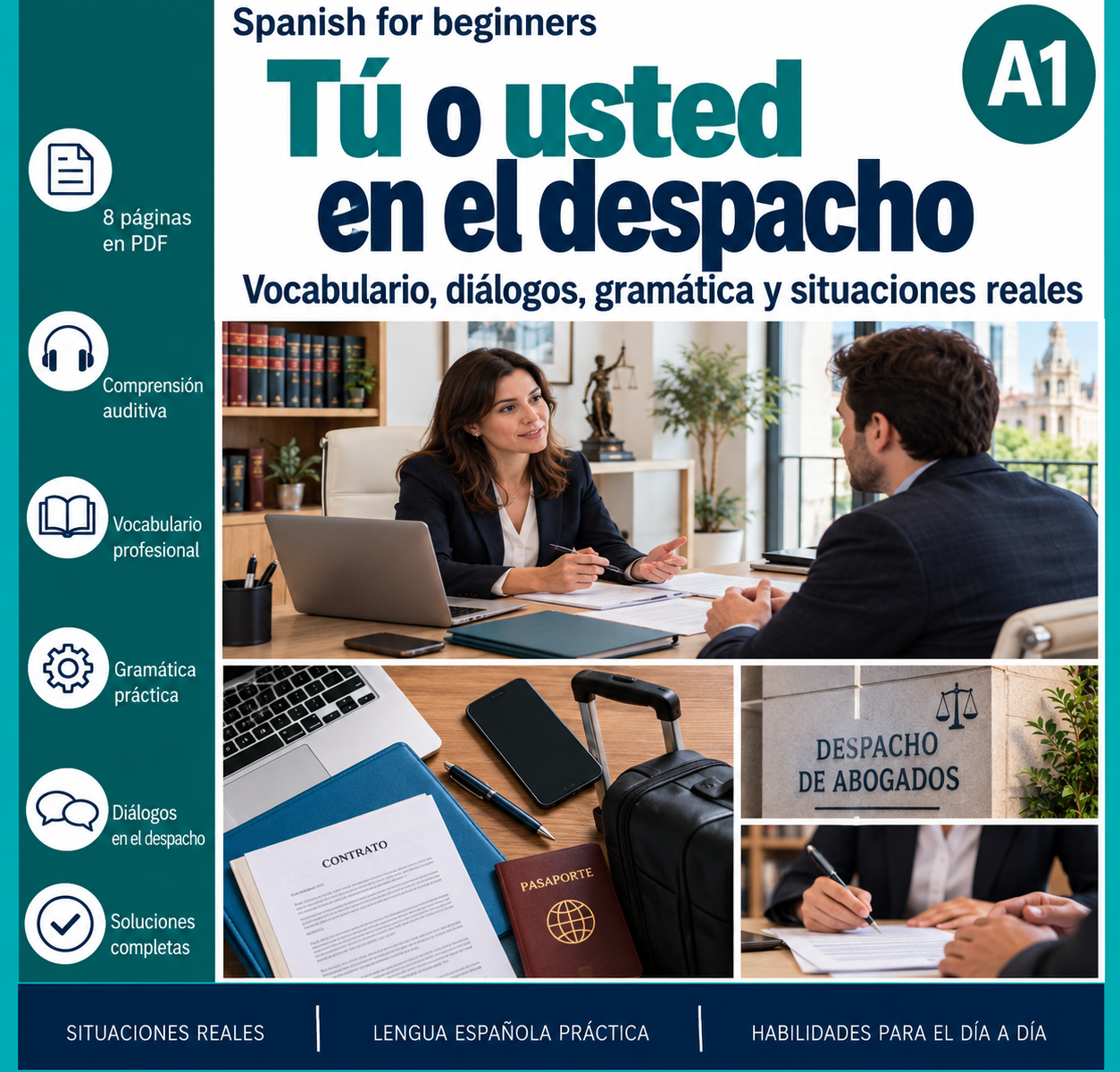
Learn how to introduce yourself, communicate with clients and colleagues, ask for personal information and arrange professional meetings in Spanish with this illustrated eight-page A1 lesson, specifically designed for beginner learners interested in legal and professional Spanish.
Tú o usted en el despacho focuses on one of the most important distinctions in Spanish communication: knowing when and how to use the informal tú and the formal usted.
Through realistic office situations, dialogues, listening activities and guided role plays, students develop the language needed for first meetings, telephone conversations and everyday interactions in a law firm.
What the lesson includes
1. Legal office vocabulary
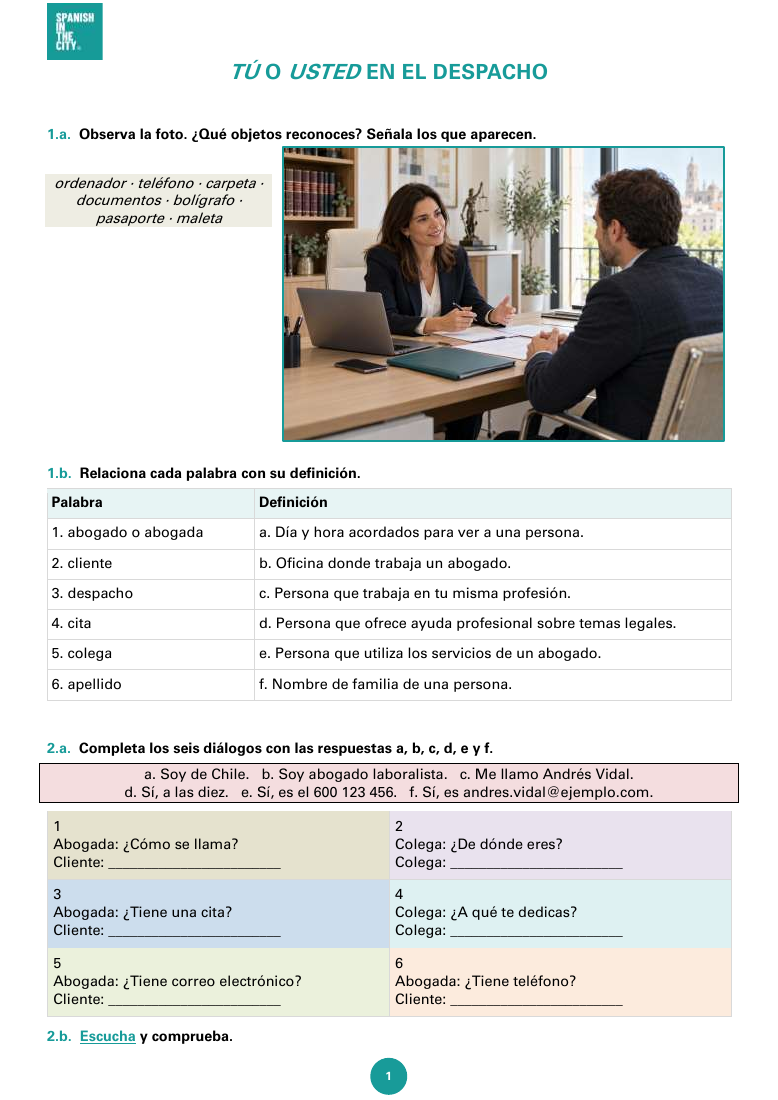
Students learn essential vocabulary such as abogado, abogada, cliente, despacho, colega, cita and apellido.
Illustrated activities introduce common office objects, while matching exercises help students understand professional vocabulary in context.
2. Tú and usted: Formal and informal communication
Students compare questions such as ¿Cómo te llamas? and ¿Cómo se llama?, ¿De dónde eres? and ¿De dónde es?, and ¿A qué te dedicas? and ¿A qué se dedica?
Activities focus on recognising formal and informal forms, transforming questions and choosing appropriate language when communicating with clients and colleagues.
The lesson also explains that the use of tú and usted varies across countries, workplaces and personal relationships.
3. Grammar: Essential present tense verbs
Students practise five important verbs in everyday professional situations:
– Ser and llamarse for introductions.
– Tener for personal information and appointments.
– Dedicarse for discussing professions.
– Poder for availability, permission and requests.
– Saber for expressing knowledge and learned abilities.
Special attention is given to the difference between saber + infinitive and poder + infinitive.
4. Reading comprehension: A first meeting with a client
An illustrated dialogue between a lawyer and a new client introduces practical questions about professional background, languages, documents, email addresses and appointments.
Students answer comprehension questions and practise useful expressions for arranging a meeting.
5. Professional communication and availability
Activities involving three professional profiles help learners discuss abilities, languages, meeting times and availability.
Students practise questions such as ¿Sabe usar el programa de videollamadas? and ¿Puede reunirse mañana?
6. Listening comprehension
Listening activities reinforce formal and informal questions, professional dialogues and meeting arrangements.
A longer telephone conversation between a lawyer and a client provides practice in identifying names, professions, contact details, languages and appointment times.
7. Guided role play: Meeting a new client
Students take the role of a lawyer receiving a new client.
Using structured role cards, they practise greetings, introductions, requesting contact details, asking about language abilities and arranging an appointment.
8. Grammar appendix and additional exercises
A dedicated grammar appendix explains eight key language points, including tú and usted, verb conjugations, saber and poder, possessives and professional questions.
An additional practice section provides eight sets of exercises to consolidate the grammar.
9. Complete answers and listening transcript
The resource includes a complete answer key and the transcript of the main listening activity.
Resource details
Level A1
Format Downloadable PDF
Length 8 pages
Topic Formal and informal communication in a legal office
Grammar Tú, usted, ser, llamarse, tener, dedicarse, saber and poder
Skills Vocabulary, reading, listening, grammar, speaking and writing
Includes Grammar appendix, additional exercises, answers and transcript
Internet access and external links
The PDF contains clickable links to accompanying listening recordings. Internet access is required to complete the audio activities. The transcript of the main listening conversation is included in the resource.
This lesson is designed exclusively for Spanish language learning and does not constitute legal or professional training.