
Description
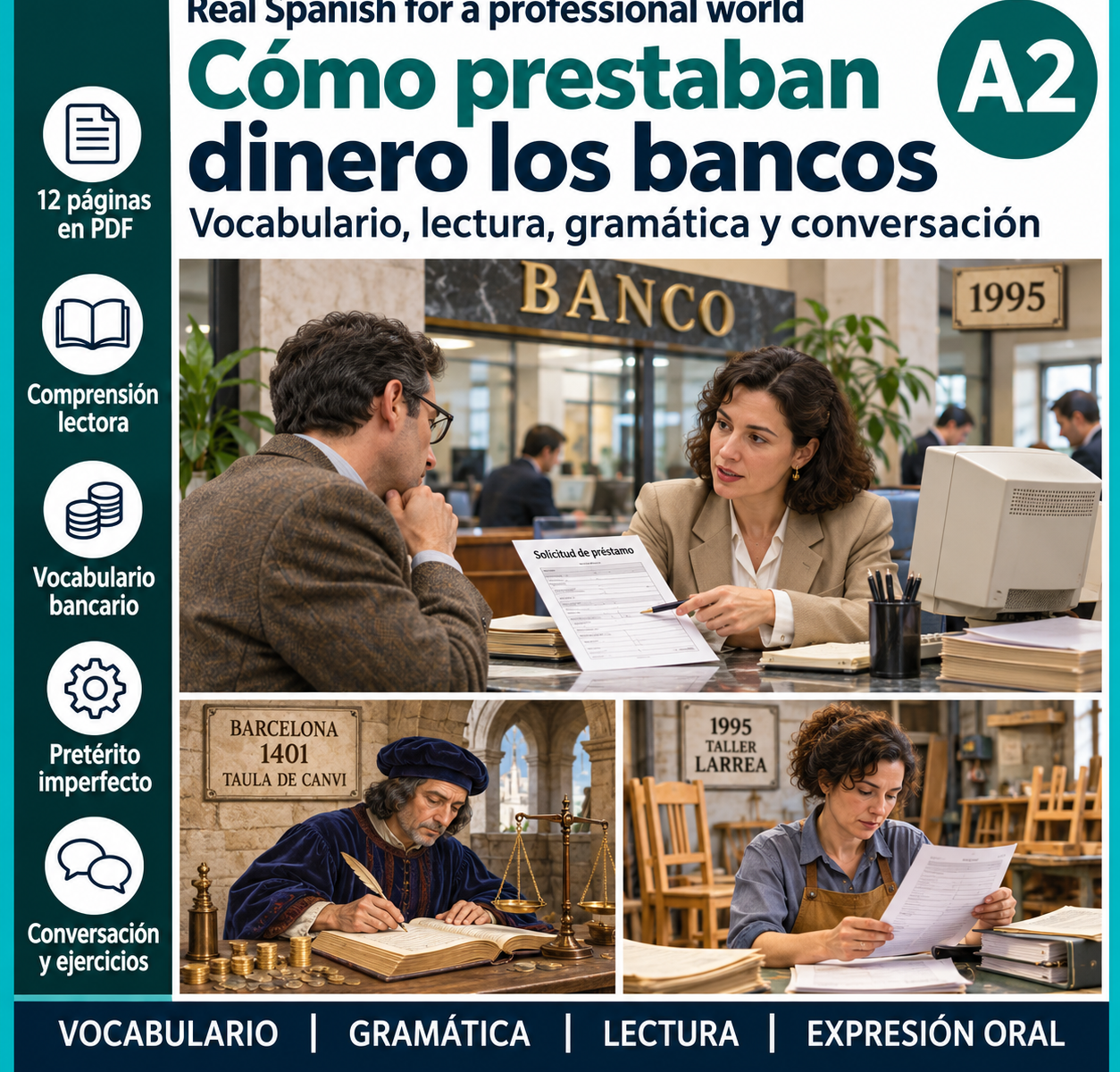
Cómo prestaban dinero los bancos is an illustrated 12-page A2 Spanish learning resource exploring how banks, businesses and commercial practices have changed over time.
Designed for adult learners and business professionals, the resource develops practical Spanish vocabulary and communication skills through historical examples, fictional business situations and comparisons between past and present.
The central grammatical focus is the pretérito imperfecto, with additional practice distinguishing it from the pretérito indefinido.
What does the resource include?
1. Illustrated introduction and banking vocabulary
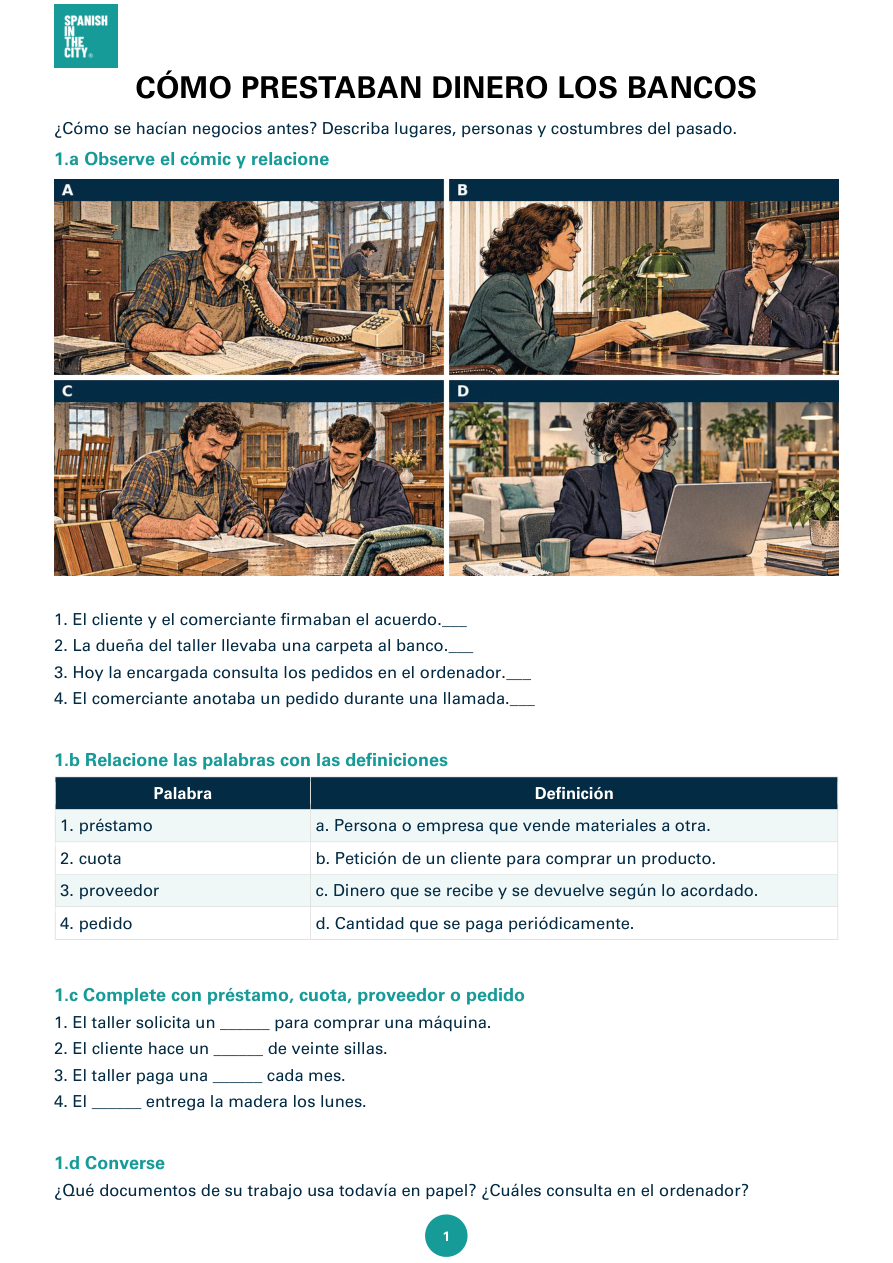
A four-panel comic introduces commercial activities, banking visits, paperwork and modern business practices.
Students learn vocabulary such as préstamo, cuota, proveedor and pedido through matching, sentence completion and guided conversation.
2. Reading: Barcelona and the Taula de Canvi (1401)
A historical reading introduces Barcelona’s Taula de Canvi, explaining how merchants deposited money, how banking operations were recorded and how the institution provided financing to the municipality.
Students complete multiple-choice and true, false or not mentioned exercises.
3. Reading: The Banco Nacional de San Carlos (1782)
Students explore the establishment of the Banco Nacional de San Carlos, its relationship with public debt, commercial credit, banknotes and shareholders.
A comparative activity examines banking practices in 1401, 1782 and 1995.
4. The Taller Larrea in 1995
A fictional furniture workshop provides a practical context for describing business routines.
Students learn how Julia and Mateo managed orders, communicated with suppliers, maintained accounts and requested bank financing.
Comprehension exercises include multiple-choice questions, true or false statements and chronological sequencing.
5. Before and now: How business practices have changed
A comparative table examines changes in:
- Customer orders
- Business records
- Loan documentation
- Commercial agreements
- Invoices
- Supplier payments
Students practise contrasting past habits with present-day practices.
6. Grammar: Pretérito imperfecto
Students learn to use the imperfect to describe:
- People and places in the past
- Repeated activities and professional routines
- Former business practices
- Background circumstances in a narrative
Exercises reinforce regular and irregular forms and the distinction between imperfect and indefinite past tenses.
7. Listening comprehension: An interview with a former bank employee
Students listen to Ernesto describe his experience working in a bank branch, including the paperwork required for loan applications and the procedures followed by customers.
Activities include selecting the main topic, identifying true and false information, completing an information sheet and interpreting expressions from the interview.
8. Guided speaking: Interviewing a former business owner
A structured role play places students in the roles of a journalist and a former business owner.
Students ask questions about customers, employees, accounting practices and bank loans, then summarise the information they have collected.
9. Comparing business practices
Guided discussion questions encourage students to compare traditional and modern ways of communicating with customers, maintaining records and requesting financing.
10. Professional writing
Students write a short account of 60 to 80 words describing a business in the past, its employees, its routines and a significant event.
The activity combines the pretérito imperfecto and pretérito indefinido.
11. Grammar appendix
A reference section explains:
- Regular imperfect conjugations
- Irregular verbs: ser, ir and ver
- Descriptions and habitual actions
- Imperfect versus indefinite
- Soler + infinitivo to describe former habits
12. Additional exercises and answers
Five supplementary exercise sets reinforce verb conjugation, tense selection, habitual actions, error correction and narrative writing.
The final page provides complete answers, model responses and the listening transcript.
Resource details
- Level: A2
- Format: Downloadable PDF
- Length: 12 pages
- Audience: Adult Spanish learners and business professionals
- Main grammar: Pretérito imperfecto
- Additional grammar: Pretérito indefinido and soler + infinitivo
- Skills: Vocabulary, reading, listening, speaking, grammar and writing
- Includes: Illustrated activities, historical readings, business case studies, listening comprehension, guided role plays, grammar appendix, additional exercises, answers and transcript
Internet access and external links
Internet access is required to access the linked listening recording. The PDF contains clickable external links for the listening activity on page 7.
The complete transcript is also included on the final page.
This resource is intended for Spanish language learning, not as banking, legal or financial advice.