
Description
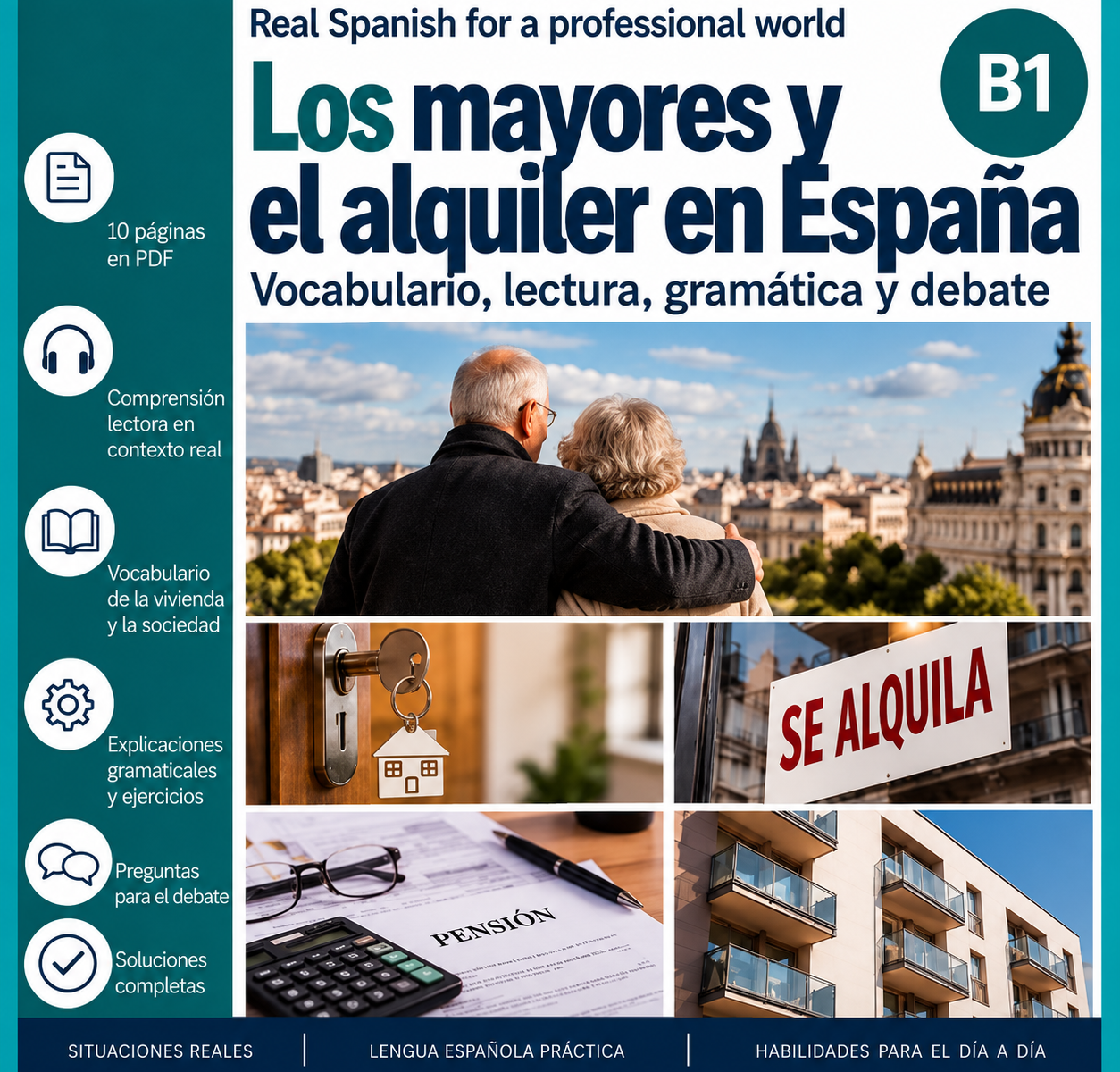
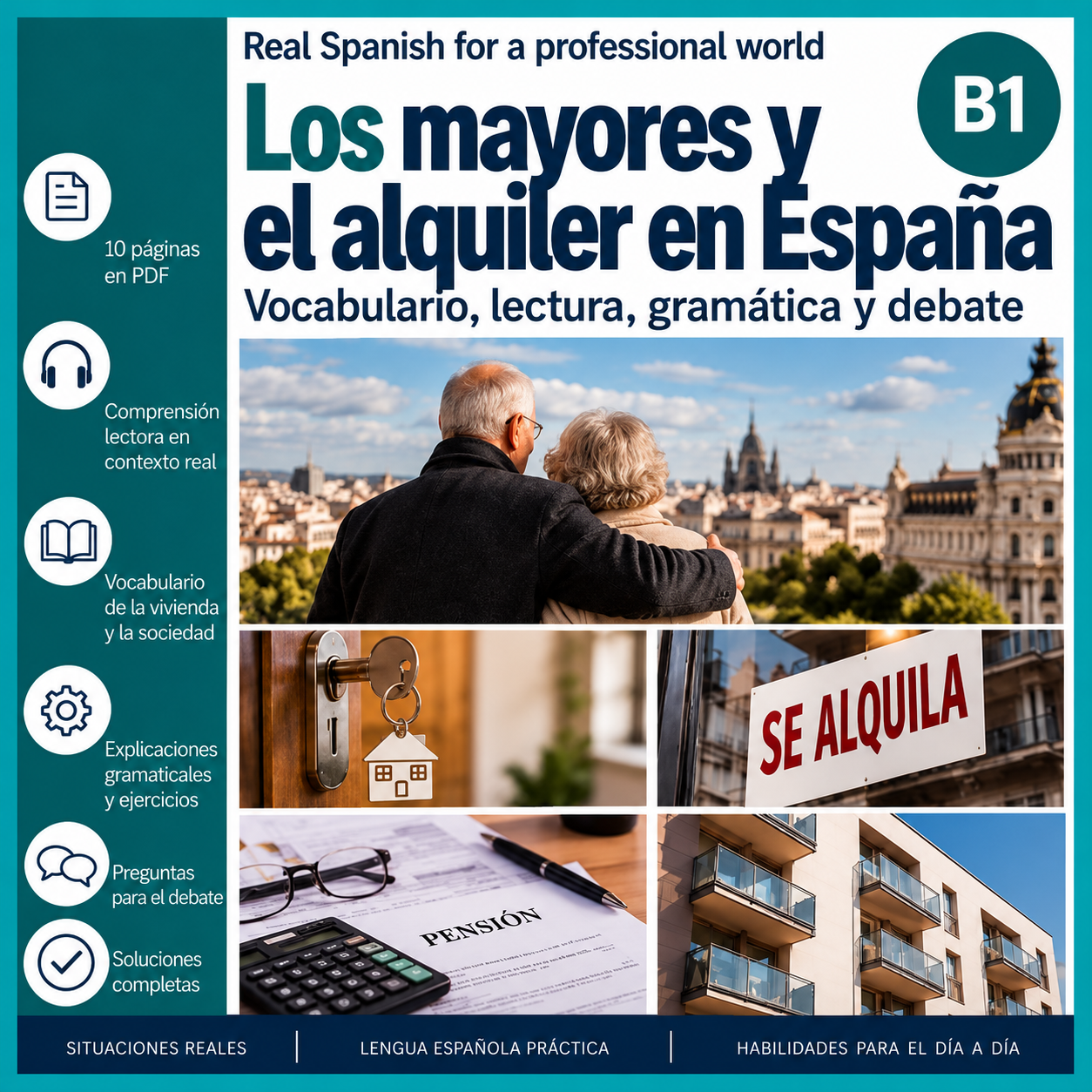
Explore the changing housing situation of older people in Spain through this comprehensive 10-page B1 Spanish lesson, combining vocabulary development, reading comprehension, grammar, statistical analysis, speaking and writing.
Based on an adapted article from El Mundo, published on 4 October 2026, the lesson examines how the proportion of older households paying market rent has changed since 2008, the differences between generations and the potential consequences for people approaching retirement.
The resource is particularly suitable for intermediate Spanish learners interested in current affairs, housing, economics and social issues.
What the lesson includes
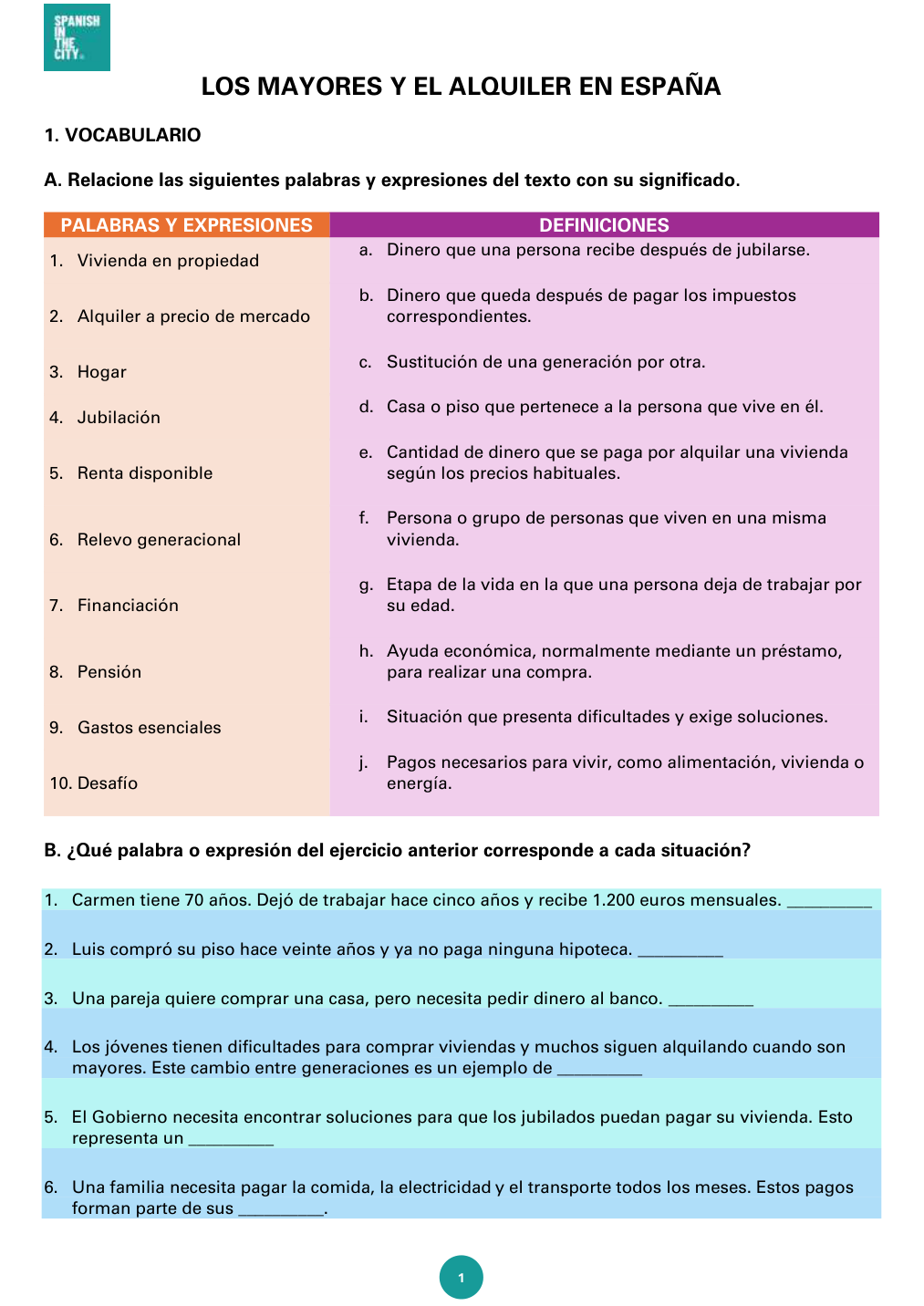
1. Vocabulary: Housing, renting and retirement
Four exercises introduce and consolidate useful expressions such as vivienda en propiedad, alquiler a precio de mercado, renta disponible, relevo generacional, financiación, pensión and gastos esenciales.
Students practise matching vocabulary with definitions, completing contextualised sentences and interpreting expressions commonly used in economic and social reporting.
2. Grammar and language use: Expressing changes and trends
Students learn to describe developments over time using structures including aumentar, disminuir, pasar de… a…, cada vez más, seguir + gerundio, mantenerse and duplicarse.
Exercises focus on choosing appropriate verb forms and reformulating sentences to describe statistical changes accurately.
3. Reading comprehension: Older people and the rental market
An adapted Spanish newspaper article explores the evolution of home ownership and renting among older households, the difficulties younger generations face when purchasing property and the possible implications for retirement.
Students complete true, false and not mentioned questions based on the reading.
4. Understanding and interpreting statistical graphs
Five statistical graphics, labelled A to E, provide opportunities to develop the language of numbers, percentages, comparisons and trends.
The activities examine changes in renting across age groups, differences between market and below-market rents, generational projections and the proportion of disposable income spent on housing.
Students practise extracting information, comparing figures and drawing conclusions from visual data.
5. Language for presenting and commenting on graphs
A dedicated section introduces expressions used to organise spoken and written statistical commentary, including:
Aquí vemos que, este gráfico muestra, por otro lado, mientras que, en cambio, sin embargo, por eso and en conclusión.
Students complete connector exercises, construct a guided graph commentary and prepare a short oral presentation.
6. Debate and written production
Six discussion questions encourage students to compare renting and home ownership, examine the challenges faced by younger generations and consider the financial implications of renting during retirement.
A final written task asks students to produce a structured commentary of 120 to 150 words, using information from the article and at least one graph.
7. Complete answer key
The resource includes answers to the vocabulary, grammar, reading comprehension and graph interpretation exercises, together with suggested responses for guided graph commentary.
| Resource details | |
|---|---|
| Level | B1 |
| Format | Downloadable PDF |
| Length | 10 pages |
| Topic | Housing, renting, ageing and retirement in Spain |
| Language focus | Describing changes, trends and statistical information |
| Skills | Vocabulary, reading, grammar, speaking and writing |
| Graphics | Five statistical graphs |
| Answers | Included |
Internet access: No external links or additional online materials are required. The reading text, graphs, exercises and answers are included in the PDF.
This resource is designed for Spanish language learning, using contemporary social and economic issues as a context for developing communication skills.