
Description
Permisos y favores en el trabajo is an illustrated nine-page A2 Spanish lesson designed for adult learners, lawyers and business professionals who want to communicate politely and confidently in workplace situations.
The lesson teaches students how to ask permission, request favours, borrow objects, accept or decline requests and suggest alternatives. Particular attention is given to the differences between tú and usted, the affirmative imperative and direct object pronouns.
Through illustrated office situations, practical dialogues, listening comprehension and guided communication activities, students develop useful Spanish for everyday professional interactions.
What does the lesson include?
1. Illustrated vocabulary and workplace situations
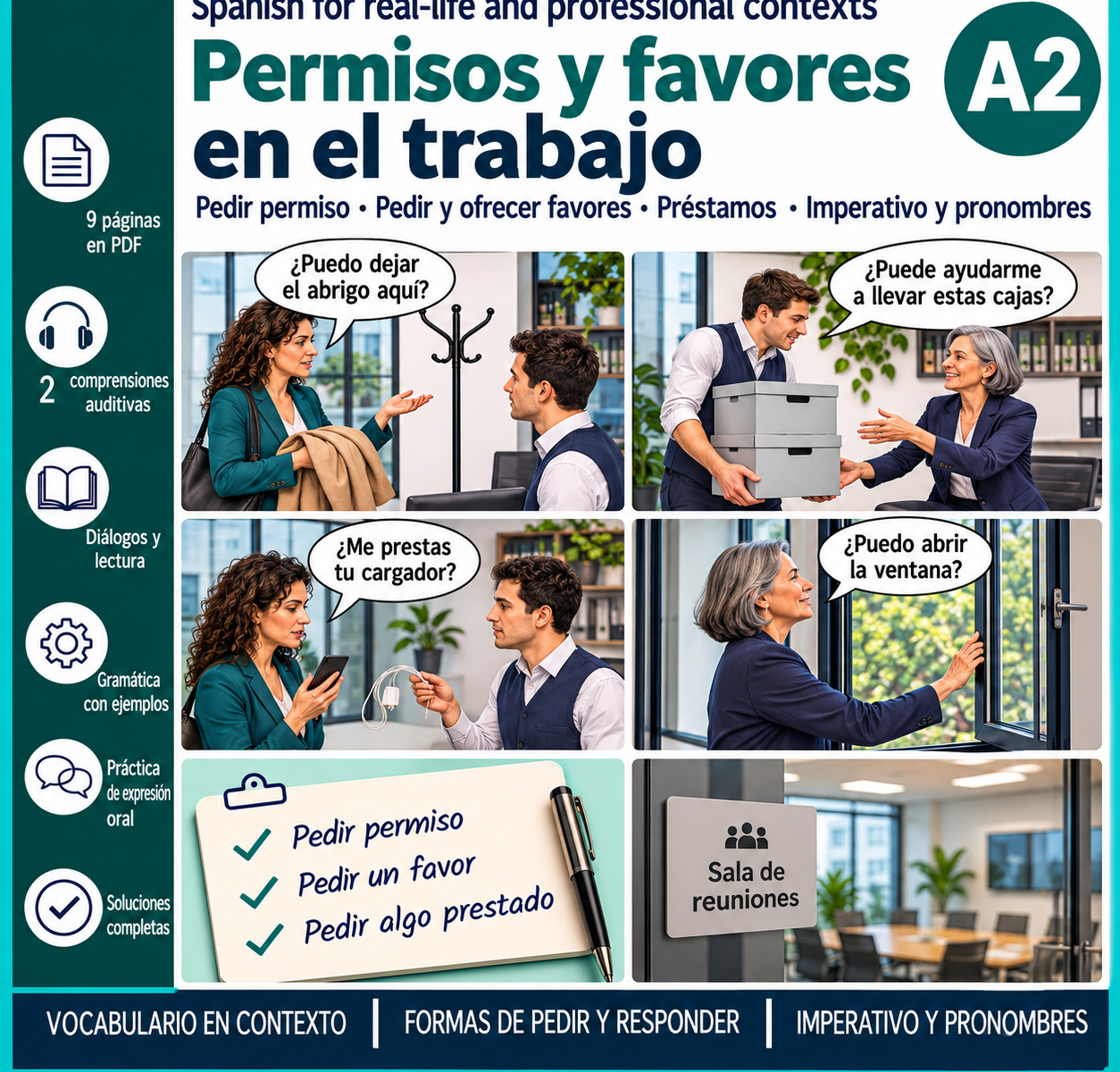
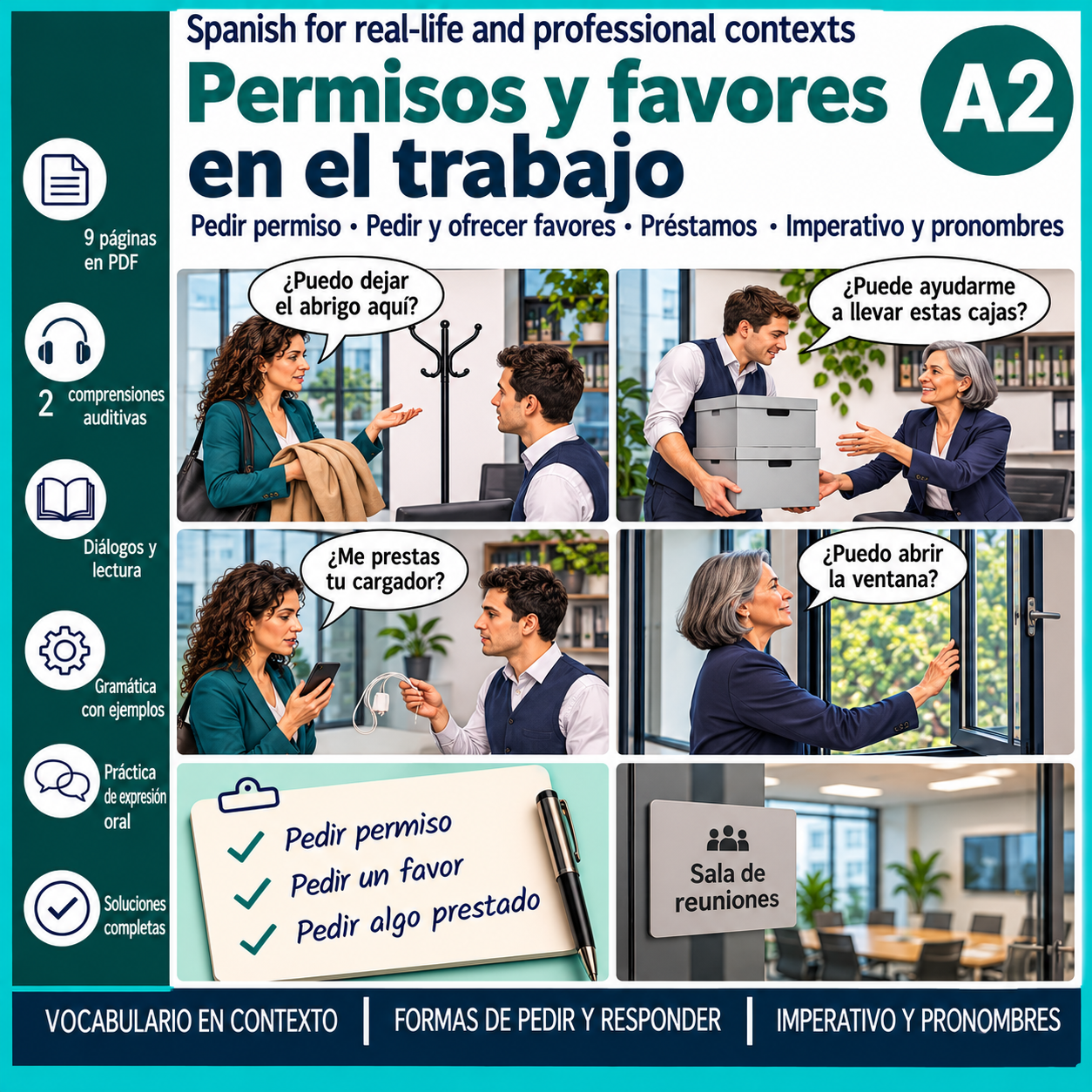
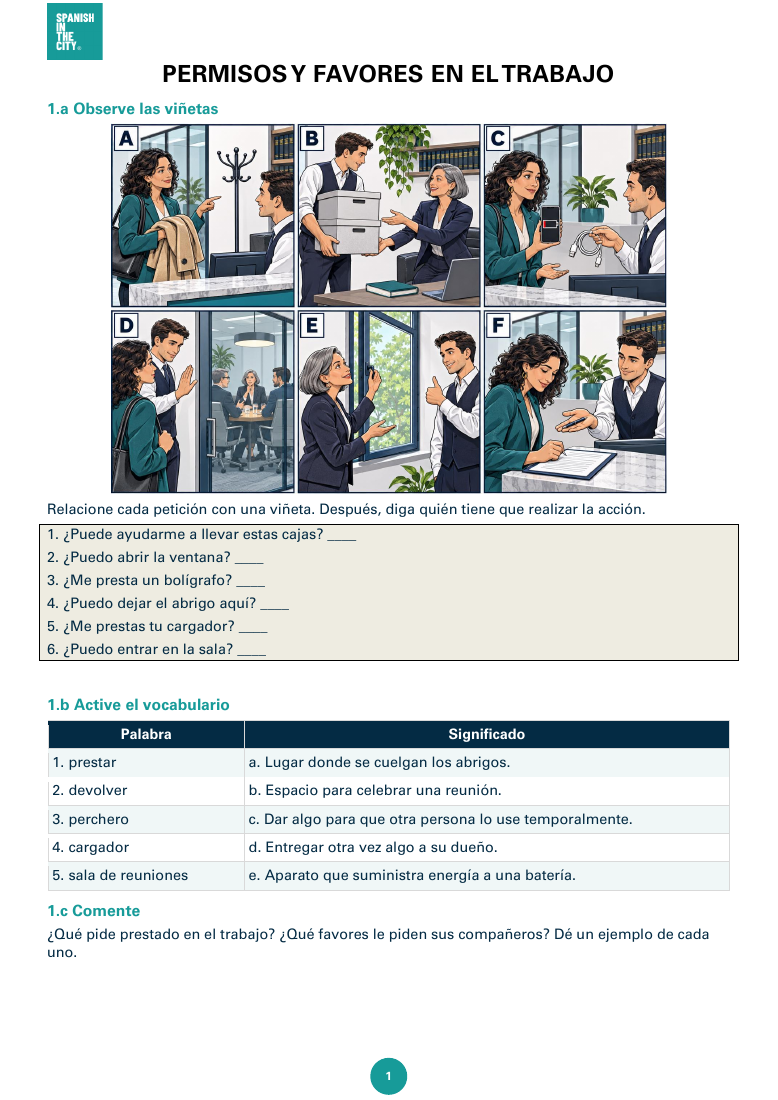
Six illustrated office scenes introduce practical requests involving carrying boxes, opening windows, borrowing chargers and pens, leaving coats and entering meeting rooms.
Students match requests to pictures, identify who must perform each action and practise vocabulary such as prestar, devolver, perchero, cargador and sala de reuniones.
2. Reading comprehension: A visit to a law office
A dialogue between a receptionist and a client introduces polite requests in a professional setting.
Students identify requests for permission, favours and borrowed objects, complete comprehension activities and practise transforming one type of request into another.
3. Grammar: Asking permission and requesting favours
Students compare essential structures:
- ¿Puedo + infinitivo? to ask permission.
- ¿Puedes / Puede + infinitivo? to request a favour.
- ¿Me prestas / presta…? to borrow something.
- ¿Se puede + infinitivo? to ask about rules.
The lesson explains how the person performing the action changes according to the structure.
4. Formal and informal communication
Students compare tú and usted in workplace situations and practise maintaining the appropriate form of address throughout a conversation.
Activities also introduce polite ways to accept, refuse or explain a difficulty using expressions such as Sí, claro, Por supuesto and Lo siento, es que…
5. Grammar: Affirmative imperative and object pronouns
Students learn to give permission using the affirmative imperative, including regular and irregular forms such as pasa, pase, haz, haga, pon and ponga.
They also practise attaching direct object pronouns to affirmative imperatives:
- Abre la puerta → Ábrela.
- Lea el informe → Léalo.
- Firma los documentos → Fírmalos.
6. Listening comprehension: Six workplace requests
Six short dialogues present different requests, including asking to leave a suitcase, borrowing a charger, requesting printing assistance and entering an office.
Students identify the type of request, whether it is accepted and the reasons or alternatives provided.
Additional activities develop listening for detail and polite intonation.
7. Listening comprehension: Preparing a meeting
A longer workplace conversation between Lucía and Omar introduces practical problems involving printing documents, borrowing a charger and requesting permission to record part of a meeting.
Students complete an information table, identify responsibilities and practise understanding object pronouns in context.
8. Guided speaking and professional writing
Illustrated speech bubbles and role cards help students practise requests in realistic workplace situations.
A role play involving a visitor and receptionist develops formal and informal communication.
Students also write a short message of 50 to 70 words requesting two favours, explaining a difficulty and borrowing an object.
9. Grammar appendix
A dedicated grammar appendix explains seven topics, including permission and favours, regular and irregular affirmative imperatives, object pronouns, polite responses and the distinction between tú and usted.
10. Additional exercises
Eight supplementary exercise sets reinforce verb forms, imperatives, pronouns, polite requests, formal and informal language, offering alternatives and constructing short dialogues.
11. Complete answers and listening transcripts
The final page includes complete answer keys, model responses and transcripts of the six short dialogues and the longer workplace conversation.
Resource details
- Level: A2
- Format: Downloadable PDF
- Length: 9 pages
- Audience: Adult Spanish learners, lawyers and business professionals
- Grammar: Permission, requests, affirmative imperative, direct object pronouns, tú and usted
- Skills: Vocabulary, reading, listening, grammar, speaking and writing
- Includes: Illustrated activities, professional dialogues, grammar appendix, additional exercises, answers and listening transcripts
Listening and internet requirements
The lesson contains listening comprehension activities and provides their complete transcripts on the final page.
Separate audio links are identified in the PDF, so the resource must be used with an internet connection.
This resource is intended for Spanish language learning, not legal or professional advice.