
Description
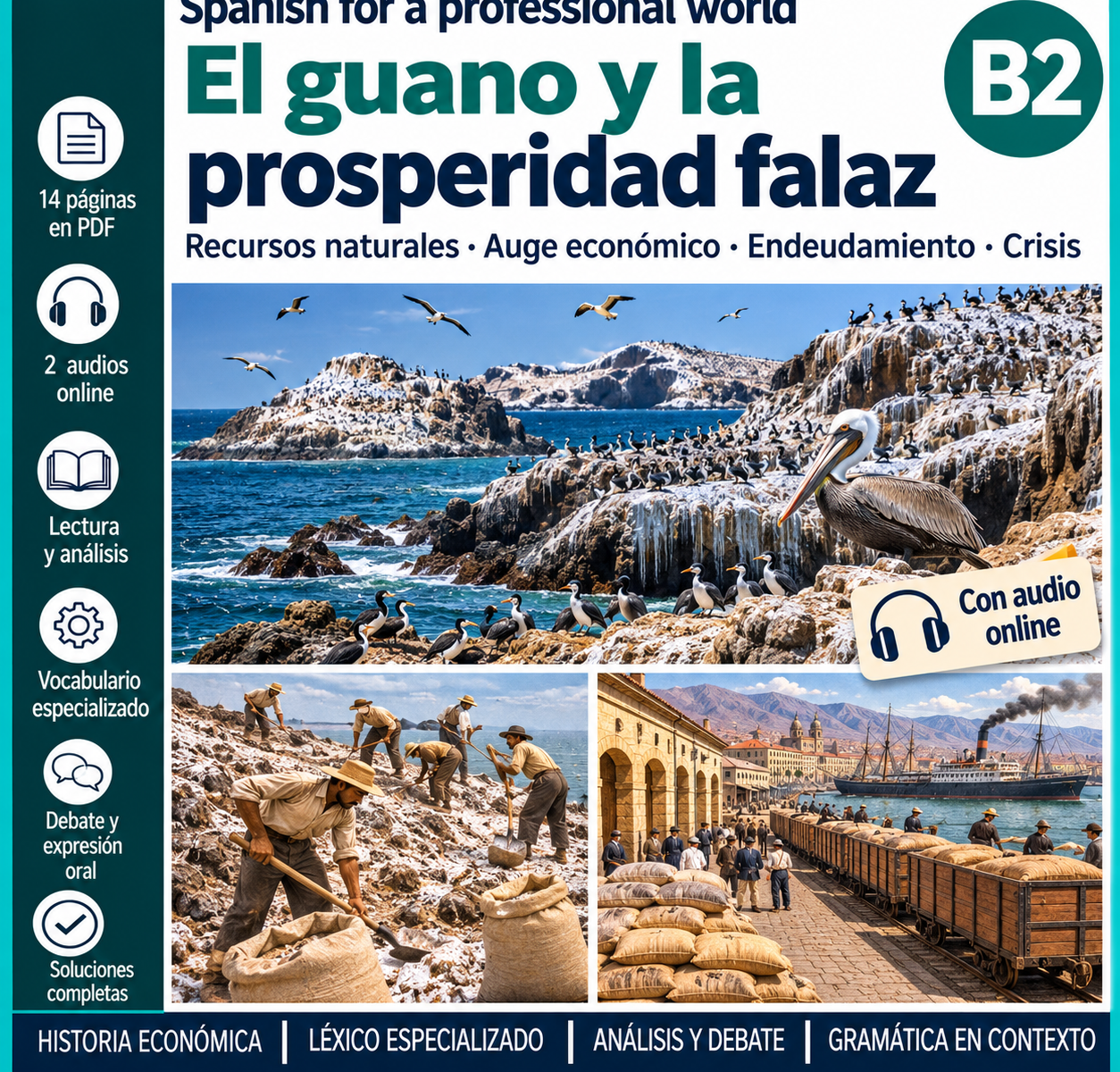
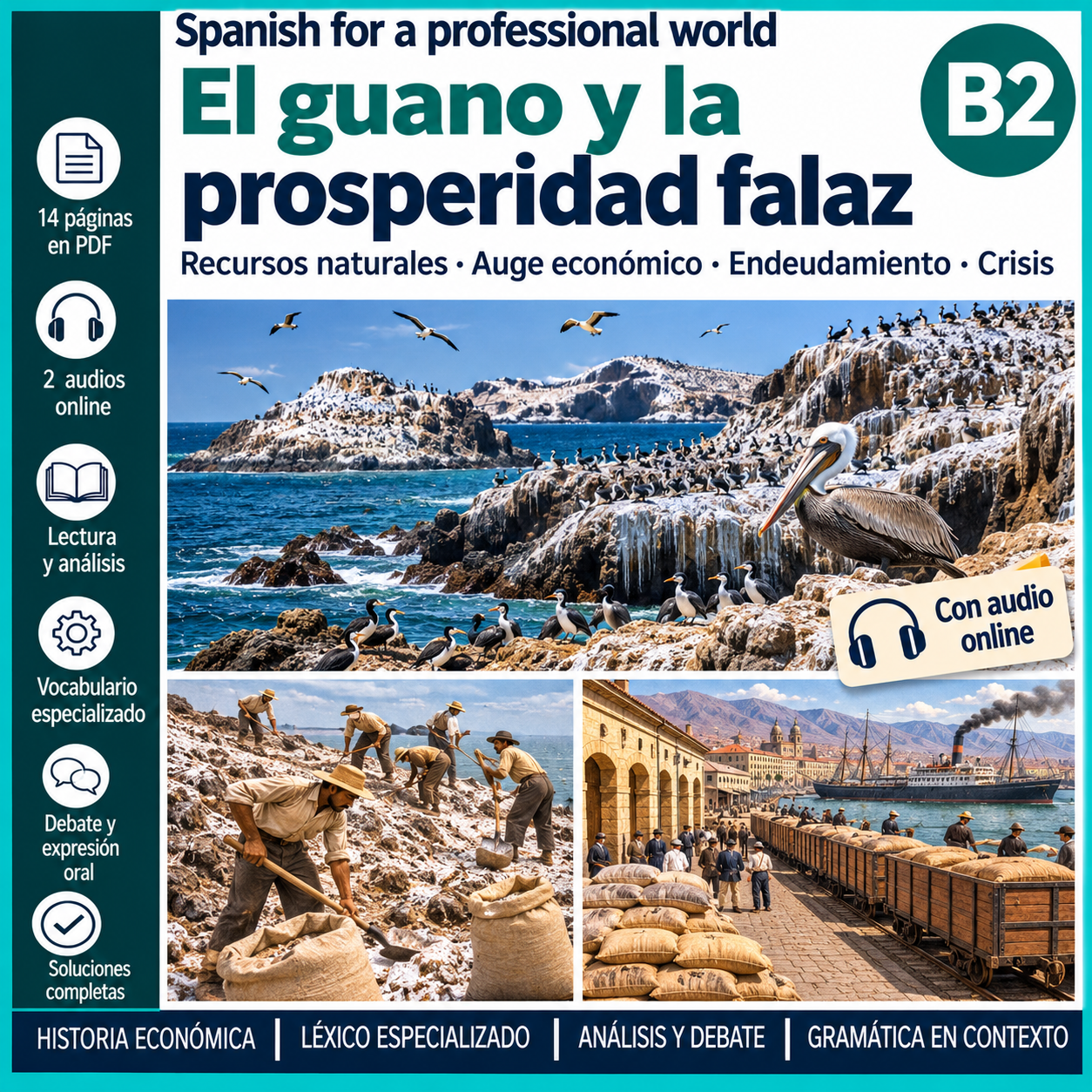
El guano y la prosperidad falaz is a comprehensive, illustrated 14-page B2 Spanish lesson exploring one of the most remarkable episodes in Latin American economic history: Peru’s nineteenth-century guano boom and the financial crisis that followed.
Designed for adult Spanish learners and professionals interested in economics, business and international affairs, this resource uses historical events to develop advanced vocabulary, reading comprehension, grammatical accuracy and the ability to analyse economic decisions in Spanish.
Students explore how an extraordinary natural resource generated substantial public revenue, financed ambitious projects and contributed to economic dependence and financial vulnerability.
The central question is: Why does a period of extraordinary prosperity not necessarily produce lasting economic development?
What does the lesson include?
1. Illustrated introduction and vocabulary activation
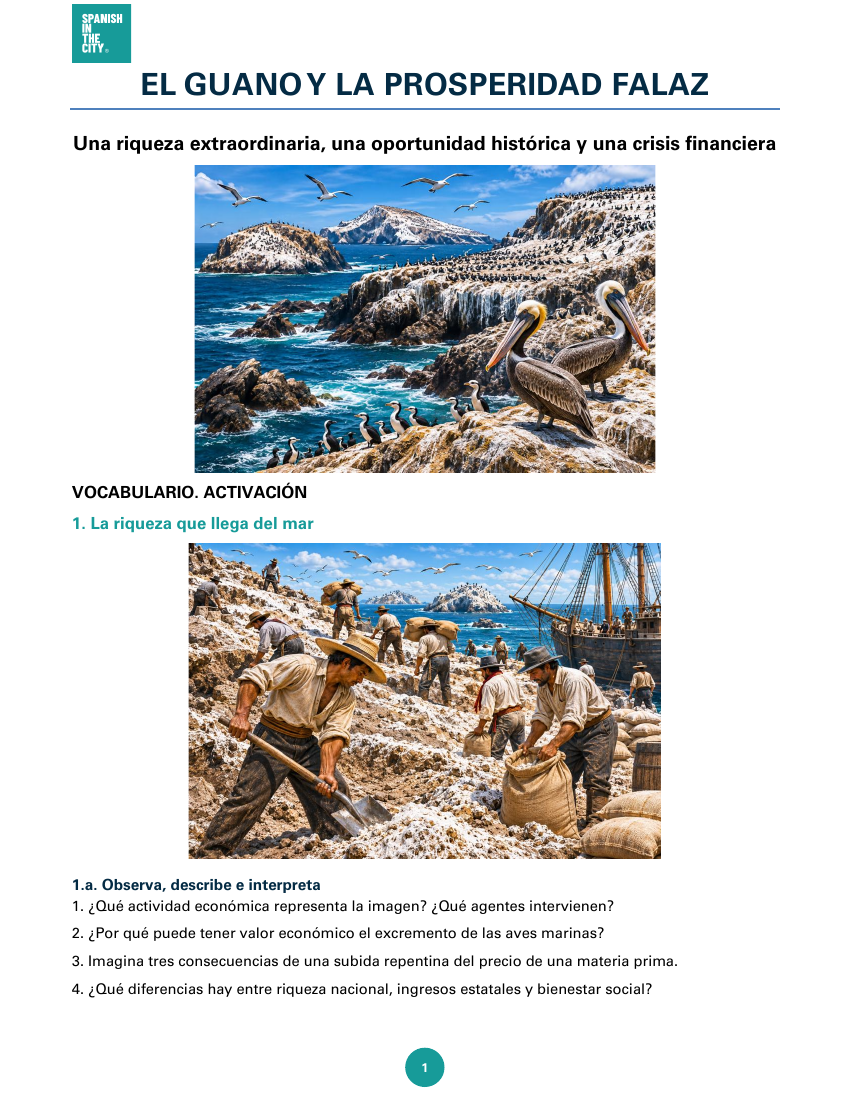
Historical illustrations introduce the extraction and international trade of guano.
Students describe economic activities, identify the participants involved and consider the relationship between natural resources, public revenue and social welfare.
2. Specialised economic vocabulary
Students develop vocabulary including bonanza, consignatario, renta fiscal, endeudamiento externo, agotamiento, diversificación, despilfarro and vulnerabilidad.
Matching, classification and sentence-completion exercises reinforce terminology associated with international trade, public finance and economic development.
3. Reading: The fertiliser that transformed Peru’s finances
An extended historical text examines the international demand for guano, the expansion of exports from the 1840s, commercial intermediaries and the 1869 Dreyfus contract.
Students practise identifying key information, distinguishing economic growth from development and summarising complex arguments.
4. Reading comprehension and critical analysis
Multiple-choice questions, true or false activities and written summaries develop detailed reading comprehension.
Students analyse the relationship between extraordinary public revenue, economic modernisation and dependence on a finite resource.
5. Railways, loans and resource depletion
A second historical text examines railway investment, external borrowing, the gradual exhaustion of guano deposits and Peru’s suspension of external debt service in 1876.
Students practise chronological sequencing, explaining causes and consequences, and evaluating economic decisions.
6. Grammar: Concession and contrast
Students learn to construct more sophisticated arguments using:
- Aunque
- A pesar de que
- Sin embargo
- No obstante
- Mientras que
- A medida que
Exercises focus on selecting appropriate connectors and reformulating sentences without changing their meaning.
7. Grammar: Unreal past and mixed hypotheses
Students practise hypothetical constructions involving the pluscuamperfecto de subjuntivo and the conditional.
Examples include:
Si el Estado hubiera ahorrado más, habría afrontado mejor la crisis.
They also practise mixed hypotheses connecting unreal past events with present consequences.
8. Interpreting an economic diagram
An illustrated diagram presents a possible relationship between extraordinary revenue, savings, investment and economic diversification.
Students practise describing diagrams, explaining relationships and preparing a structured oral presentation using formal connectors.
9. Role play: Council of Finance, Lima, 1865
Students participate in a simulated historical policy discussion.
One participant represents a minister defending railway investment, while another acts as a financial adviser concerned about borrowing and dependence on guano revenues.
The activity includes preparation cards, negotiation rounds, critical questions and a written agreement.
10. Comparative economic debate
Students examine other commodity-dependent economies, including examples involving Chilean nitrate, petroleum and lithium.
Guided questions encourage discussion of price volatility, technological substitution, export dependence and long-term economic planning.
11. Grammar appendix
A reference section summarises the structures used to analyse economic processes, including concession, contrast, cause, consequence, unreal past conditions and mixed hypotheses.
It also explains common grammatical errors.
12. Additional exercises
Two supplementary sections provide vocabulary and grammar practice.
Activities include economic collocations, lexical distinctions, hypothetical constructions, sentence correction and argument reformulation.
13. Final revision and oral presentation
A recap section consolidates the principal concepts and linguistic structures.
Students prepare a three-minute presentation entitled El guano peruano: de la bonanza al riesgo fiscal.
14. Answer key
The final page contains answers to the closed exercises and identifies activities that allow different justified responses.
Resource details
- Level: B2
- Format: Downloadable PDF
- Length: 14 pages
- Audience: Adult Spanish learners, business professionals and learners interested in economics and international affairs
- Grammar: Concession, contrast, causal and consequential connectors, unreal past hypotheses and mixed conditionals
- Skills: Reading, vocabulary, grammar, analysis, debate, speaking and writing
- Includes: Historical illustrations, economic diagrams, extended readings, guided debates, a negotiation role play, grammar appendix, additional exercises and answer key
Internet access and external links
Internet access is required. The PDF contains external links associated with listening and reading activities.
Students will need an internet connection to access the linked material.
The resource is intended for Spanish language learning and the development of communication skills. It is not a course in economics or financial advice.