La palabra del día: causante

Online Business Spanish

Noun.
From the Latin causans, causantis, the active participle of the verb causari (to cause, to give rise to), itself derived from causa (reason, motive). It is formed from the root caus- and the suffix -nte, which denotes an agent, that is, the one who performs the action.

Causante refers to the person who causes, originates, or gives rise to a fact, situation, or right.

Example
El virus fue el causante de la enfermedad.
The virus was the cause of the disease.

In Legal Spanish, the term has a precise technical meaning:
it refers to the person from whom a right originates, and more specifically, to the deceased in matters of succession, that is, the person whose estate is transmitted to the heirs.

Example
Los bienes del causante se transmitirán conforme a lo dispuesto en el testamento.
The assets of the deceased will be transferred in accordance with the provisions of the will.

Regional usage (Mexico):
In Mexican legal and administrative Spanish, causante is also used as a synonym for taxpayer, meaning the person subject to a tax obligation. dc

La palabra del día: Testar

Online Business Spanish Courses

Verb. From Latin testāri: to bear witness, to testify.

Testar is an interesting verb in legal Spanish, as it is used mainly in legal contexts and has little presence in everyday language.

1. To make a will
This is the traditional and primary meaning: to dispose of one’s assests upon death. See testamento.

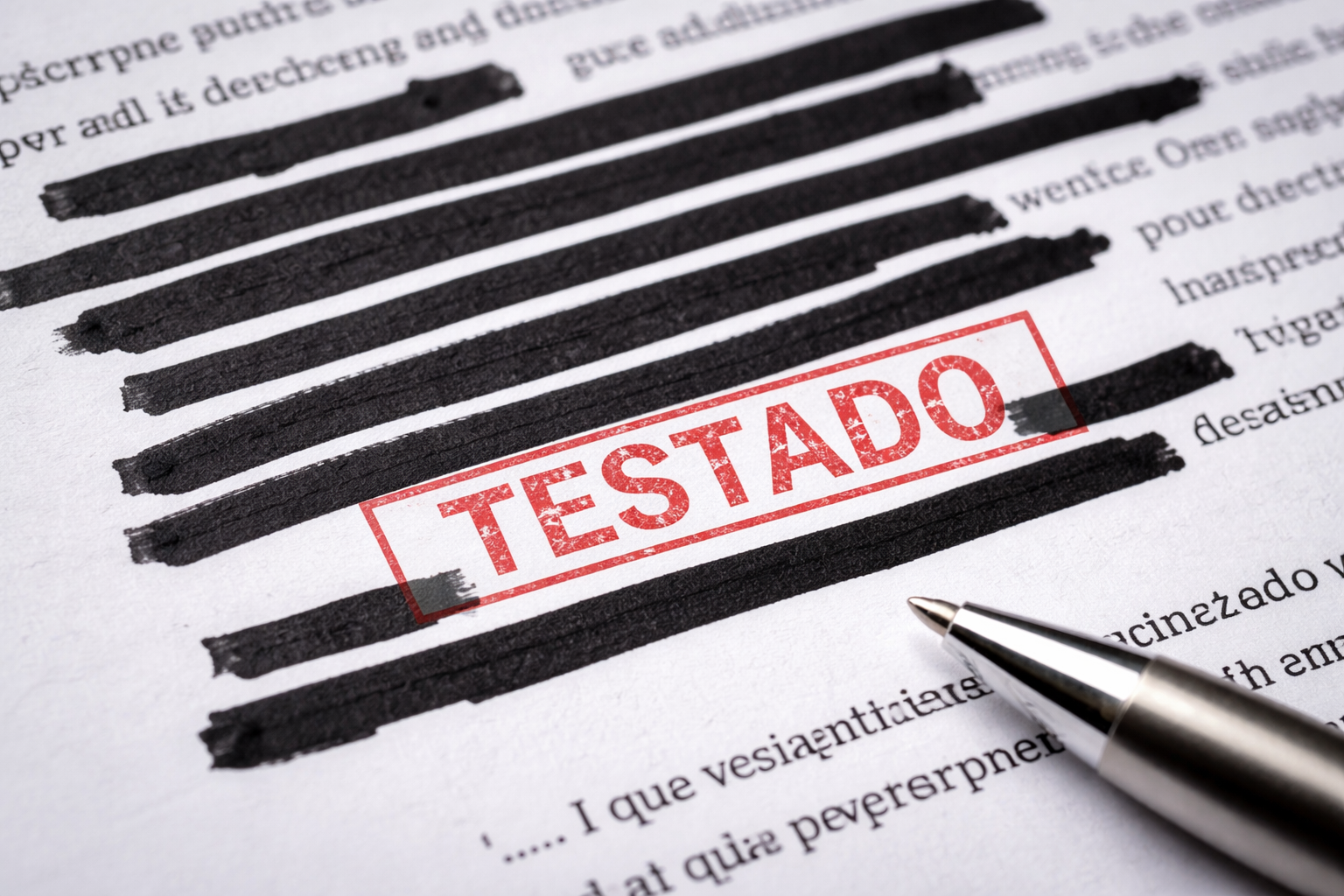
2. To strike out or delete part of a legal document
In documentary and legal practice, testar means to delete, strike through, or render ineffective a part of a legal text.

In English, the closest equivalent is to redact.

⚠️ False friend alert:
In Spanish, redactar does not mean “to delete” but rather to draft or write a text (for example, to draft a contract: redactar un contrato).

3. Modern usage: “to test”
There is a third meaning of testar in contemporary Spanish, influenced by the English verb to test, with the sense of to try or to test something (a system, a process, a product).

From a prescriptive point of view, the RAE recommends:

  • probar
  • poner a prueba

In practice, however, many speakers prefer testear, while using testar with this meaning can be confusing in legal contexts.

Spot the meaning of TESTAR from context

1 / 6

1. Las cláusulas testadas no deben tenerse en cuenta en la interpretación del contrato.

2 / 6

2. El desarrollador quiere testar la nueva plataforma antes del lanzamiento.

3 / 6

3. El notario confirmó que el testador había testado libremente.

4 / 6

4. Antes de la publicación, se testaron varios párrafos por razones de confidencialidad.

5 / 6

5. Las referencias al nombre del menor han sido testadas del documento.

6 / 6

6. El causante testó a favor de sus dos hijas.

Your score is

La palabra del día: Saneamiento

Business spanish lessons

Masculine noun. Fom the verb sanear, itself derived from the Latin sanare — “to heal, make sound, or restore to health.”
In everyday Spanish, sanear still keeps that sense of “cleaning up,” “restoring,” or “making something right.”

In legal Spanish, this original meaning survives metaphorically: to “make good” a defect, flaw, or loss suffered by another person. Hence, saneamiento in law refers to the seller’s duty to “restore” the buyer’s position when the thing sold turns out not to be as promised. In Civil law, saneamiento refers to the seller’s legal obligation to compensate or indemnify the buyer if certain problems arise with the thing sold.
In other words, when someone sells something, they are not only transferring ownership — they are also taking on certain risks. Saneamiento is the legal guarantee that protects the buyer if a defect or loss occurs.

This obligation appears mainly in two situations:

  1. Saneamiento por evicción (warranty against eviction): when the buyer is deprived, wholly or partly, of the purchased item because a third party has a prior right and successfully enforces it in court.
  2. Saneamiento por vicios ocultos (warranty for hidden defects): when the item sold has hidden defects existing at the time of sale that make it unfit for its intended use or reduce its value so much that, had the buyer known, they would not have bought it or would have paid less.

English equivalents

There isn’t always a perfect English counterpart, but roughly:

  • Saneamiento por evicciónwarranty against eviction / indemnity for loss of title or possession
  • Saneamiento por vicios ocultoswarranty for hidden (or latent) defects

In practice, bilingual contracts may refer to seller’s warranties or seller’s indemnity obligations, but translating saneamiento simply as “remedy” or “indemnity” loses nuance: the verb sanear literally means “to make something right or sound again.”

Example in context

Spanish:

«El contrato estipula que el vendedor queda obligado al saneamiento por vicios ocultos previsto en el artículo 1484 del Código Civil, de modo que si la vivienda presenta defectos graves no visibles al adquirente, este podrá optar por la acción redhibitoria o la acción quanti minoris

English (approximate translation):

“The contract stipulates that the seller is liable under the warranty for hidden defects provided in Article 1484 of the Civil Code, so that if the dwelling has serious latent defects not visible to the purchaser, the latter may opt either to rescind the contract (redhibitory action) or to seek a price reduction (quanti minoris action).”

Notes for professionals

  • In sales contracts (for property, businesses, or movable goods), it’s crucial to identify these saneamiento obligations and specify any waivers or limitations. For instance, under Civil law a buyer can waive the right to saneamiento por evicción, but only expressly — and not if the seller acted in bad faith.
  • For bilingual legal professionals, this makes saneamiento a good example of a “false friend”: it looks like “sanitation” or “clean-up,” yet in legal Spanish it means a statutory seller’s warranty.
  • In sworn translations or international contracts, if the target jurisdiction has no direct equivalent, it’s best to add a clarifying clause such as: “For the purposes of this Agreement, saneamiento refers to the seller’s statutory liability for hidden defects or for eviction, as applicable.” dc

La palabra del día: Suplir

Business Spanish Courses. Legal Spanish vocabulary

Suplir is a verb often used in legal Spanish. It comes from the Latin supplēre, “to fill up, to make complete.” In law, it refers to providing, covering, or replacing something that is missing.

Typical uses include:

  • Suplir un defecto de forma – to remedy a formal defect in a contract or procedure.
  • Suplir la omisión de un requisito – to supply a missing legal requirement.
  • El juez puede suplir la falta de capacidad procesal – the judge may cover for the lack of procedural capacity.

The central idea is that suplir allows the law, a judge, or even a party to fill in what is missing, so that a case or document can move forward.

The noun form is suplencia, meaning the act of substitution or replacement.

  • Durante la suplencia del juez titular, actuó el suplente.

Related words:

  • suplente – substitute, deputy, stand-in.
  • suplidor – supplier (more common in Latin America for “proveedor”).

Have you come across suplir or suplencia in contracts or legal texts in Spanish? dc

Ejercicio: Terminación Anticipada

Cláusula X – Terminación Anticipada por Incumplimiento
En caso de incumplimiento material de cualquiera de las obligaciones esenciales del Contrato, no subsanado dentro de un plazo de treinta (30) días desde la notificación escrita de la Parte Cumplidora, la Parte Afectada podrá declarar la terminación anticipada del Contrato, sin perjuicio de su derecho a reclamar daños y perjuicios.

Cláusula Y – Terminación Anticipada por Conveniencia
Cualquiera de las Partes podrá dar por terminado el Contrato de manera anticipada, sin necesidad de alegar causa, mediante notificación escrita cursada con una antelación mínima de noventa (90) días a la otra Parte. En tal supuesto, no procederá indemnización distinta de la liquidación de las obligaciones devengadas hasta la fecha efectiva de terminación.

Relacione las palabras de la izquierda con la expresión correcta de la derecha:

1 / 1

1. Relacione las palabras de la izquierda con la expresión correcta de la derecha:

1. Terminación
Incumplimiento
Notificación
Derecho a
Obligaciones
Plazo de

Your score is

Elija la redacción más adecuada

1 / 1

1. ¿Qué versión refleja mejor el estilo jurídico-contractual de las cláusulas sobre terminación anticipada? Dos respuestas.

Your score is

La palabra del día: Recurrir

legal spanish

As part of our business Spanish courses online and legal Spanish vocabulary series, today’s word is recurrir — an essential term for legal appeals and challenges in court.

From the Latin recorrere (“to run again”), the Spanish verb recurrir in legal contexts functions as a synonym of presentar or interponer un recurso. And what is a recurso? It is a legal mechanism available to the parties in a proceeding to challenge a judgment or resolution issued by a judge or authority.

The most well-known recurso is the recurso de apelación—an appeal. So, if an apelación is a recurso, that implies there are others, such as recurso de nulidad, recurso de queja, recurso de inconstitucionalidad, etc.

When you encounter the phrase sentencia recurrible, it means that the decision can be challenged through any form of recurso. On the other hand, if we say that a sentence is apelable, we’re specifying that it can be appealed, but we’re not necessarily indicating that it’s open to other types of recursos.

Learn more terms like this in our full business Spanish courses online. dc


Spanish in the City® — Legal & Business Spanish courses for lawyers, bankers, civil servants, diplomats and executives.
© 2016–2026. All rights reserved. Spanish in The City® is the trading name of Daniel Cristiano, registered with HMRC as a sole trader in the UK.
add me
Whatsapp