

This blog focuses on the language of contracts, litigation, regulatory matters, cross-border transactions and formal communication. Articles analyse vocabulary, usage, register and recurring drafting issues faced by lawyers, bankers, diplomats and senior professionals working with Spanish in high-stakes environments.
This is not general Spanish. It is Spanish for Lawyers and bankers who require precision, nuance and control — the level of language needed in negotiations, boardrooms, legal documents and institutional settings.
This blog is expressly curated to foster a comprehensive understanding of the Spanish language. While every effort is made to ensure the accuracy of the information presented herein, it should be noted that this blog does not purport to offer legal, financial, or any professional counsel. Moreover, it is not designed to facilitate instruction in translation, nor does it provide lectures or courses pertaining to law, finance, or any commercial disciplines. The principal objective remains to assist readers in navigating and comprehending the subtleties of the Spanish language. No reliance should be placed on any content published on this blog for the purposes of legal, financial, business, or other real-world decision-making.
- La palabra del día: Inmisión

Noun. From the Latin immissio, -ōnis, derived from the verb immittere (to introduce, to bring in, to project inwards). It is formed from the prefix in- (within) and the verb mittere (to send, to throw).
Inmisión refers to the introduction or projection of elements (noise, smoke, odours, vibrations, heat, light, etc.) from one property or activity that affect another, usually without direct physical contact.
In Legal Spanish, the term is primarily used in civil law and property law, especially in relation to limitations on property rights and neighbourly relations. Inmisiones occur when a lawful activity on one property produces harmful effects on another.
Example
Las inmisiones de ruido procedentes del local exceden los límites tolerables y vulneran el derecho del propietario colindante.
→ The noise emissions coming from the premises exceed tolerable limits and infringe the neighbouring owner’s rights.Terminological note
Inmisión is a technical term in civil law and does not have a single, exact equivalent in common law. Depending on the context, it is usually translated as emissions, nuisance, or interference. dc - La palabra del día: causante

Noun.
From the Latin causans, causantis, the active participle of the verb causari (to cause, to give rise to), itself derived from causa (reason, motive). It is formed from the root caus- and the suffix -nte, which denotes an agent, that is, the one who performs the action.Causante refers to the person who causes, originates, or gives rise to a fact, situation, or right.
Example
El virus fue el causante de la enfermedad.
→ The virus was the cause of the disease.In Legal Spanish, the term has a precise technical meaning:
it refers to the person from whom a right originates, and more specifically, to the deceased in matters of succession, that is, the person whose estate is transmitted to the heirs.Example
Los bienes del causante se transmitirán conforme a lo dispuesto en el testamento.
→ The assets of the deceased will be transferred in accordance with the provisions of the will.Regional usage (Mexico):
In Mexican legal and administrative Spanish, causante is also used as a synonym for taxpayer, meaning the person subject to a tax obligation. dc - La palabra del día: Testar
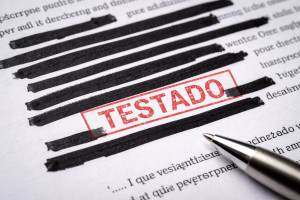
Verb. From Latin testāri: to bear witness, to testify.
Testar is an interesting verb in legal Spanish, as it is used mainly in legal contexts and has little presence in everyday language.
1. To make a will
This is the traditional and primary meaning: to dispose of one’s assests upon death. See testamento.2. To strike out or delete part of a legal document
In documentary and legal practice, testar means to delete, strike through, or render ineffective a part of a legal text.In English, the closest equivalent is to redact.
⚠️ False friend alert:
In Spanish, redactar does not mean “to delete” but rather to draft or write a text (for example, to draft a contract: redactar un contrato).3. Modern usage: “to test”
There is a third meaning of testar in contemporary Spanish, influenced by the English verb to test, with the sense of to try or to test something (a system, a process, a product).From a prescriptive point of view, the RAE recommends:
- probar
- poner a prueba
In practice, however, many speakers prefer testear, while using testar with this meaning can be confusing in legal contexts.
- La palabra del día: Saneamiento

Masculine noun. Fom the verb sanear, itself derived from the Latin sanare — “to heal, make sound, or restore to health.”
In everyday Spanish, sanear still keeps that sense of “cleaning up,” “restoring,” or “making something right.”In legal Spanish, this original meaning survives metaphorically: to “make good” a defect, flaw, or loss suffered by another person. Hence, saneamiento in law refers to the seller’s duty to “restore” the buyer’s position when the thing sold turns out not to be as promised. In Civil law, saneamiento refers to the seller’s legal obligation to compensate or indemnify the buyer if certain problems arise with the thing sold.
In other words, when someone sells something, they are not only transferring ownership — they are also taking on certain risks. Saneamiento is the legal guarantee that protects the buyer if a defect or loss occurs.This obligation appears mainly in two situations:
- Saneamiento por evicción (warranty against eviction): when the buyer is deprived, wholly or partly, of the purchased item because a third party has a prior right and successfully enforces it in court.
- Saneamiento por vicios ocultos (warranty for hidden defects): when the item sold has hidden defects existing at the time of sale that make it unfit for its intended use or reduce its value so much that, had the buyer known, they would not have bought it or would have paid less.
English equivalents
There isn’t always a perfect English counterpart, but roughly:
- Saneamiento por evicción → warranty against eviction / indemnity for loss of title or possession
- Saneamiento por vicios ocultos → warranty for hidden (or latent) defects
In practice, bilingual contracts may refer to seller’s warranties or seller’s indemnity obligations, but translating saneamiento simply as “remedy” or “indemnity” loses nuance: the verb sanear literally means “to make something right or sound again.”
Example in context
Spanish:
«El contrato estipula que el vendedor queda obligado al saneamiento por vicios ocultos previsto en el artículo 1484 del Código Civil, de modo que si la vivienda presenta defectos graves no visibles al adquirente, este podrá optar por la acción redhibitoria o la acción quanti minoris.»
English (approximate translation):
“The contract stipulates that the seller is liable under the warranty for hidden defects provided in Article 1484 of the Civil Code, so that if the dwelling has serious latent defects not visible to the purchaser, the latter may opt either to rescind the contract (redhibitory action) or to seek a price reduction (quanti minoris action).”
Notes for professionals
- In sales contracts (for property, businesses, or movable goods), it’s crucial to identify these saneamiento obligations and specify any waivers or limitations. For instance, under Civil law a buyer can waive the right to saneamiento por evicción, but only expressly — and not if the seller acted in bad faith.
- For bilingual legal professionals, this makes saneamiento a good example of a “false friend”: it looks like “sanitation” or “clean-up,” yet in legal Spanish it means a statutory seller’s warranty.
- In sworn translations or international contracts, if the target jurisdiction has no direct equivalent, it’s best to add a clarifying clause such as: “For the purposes of this Agreement, saneamiento refers to the seller’s statutory liability for hidden defects or for eviction, as applicable.” dc
- La palabra del día: Suplir
Suplir is a verb often used in legal Spanish. It comes from the Latin supplēre, “to fill up, to make complete.” In law, it refers to providing, covering, or replacing something that is missing.
Typical uses include:
- Suplir un defecto de forma – to remedy a formal defect in a contract or procedure.
- Suplir la omisión de un requisito – to supply a missing legal requirement.
- El juez puede suplir la falta de capacidad procesal – the judge may cover for the lack of procedural capacity.
The central idea is that suplir allows the law, a judge, or even a party to fill in what is missing, so that a case or document can move forward.
The noun form is suplencia, meaning the act of substitution or replacement.
- Durante la suplencia del juez titular, actuó el suplente.
Related words:
- suplente – substitute, deputy, stand-in.
- suplidor – supplier (more common in Latin America for “proveedor”).
Have you come across suplir or suplencia in contracts or legal texts in Spanish? dc
- Ejercicio: Terminación Anticipada
Cláusula X – Terminación Anticipada por Incumplimiento
En caso de incumplimiento material de cualquiera de las obligaciones esenciales del Contrato, no subsanado dentro de un plazo de treinta (30) días desde la notificación escrita de la Parte Cumplidora, la Parte Afectada podrá declarar la terminación anticipada del Contrato, sin perjuicio de su derecho a reclamar daños y perjuicios.Cláusula Y – Terminación Anticipada por Conveniencia
Cualquiera de las Partes podrá dar por terminado el Contrato de manera anticipada, sin necesidad de alegar causa, mediante notificación escrita cursada con una antelación mínima de noventa (90) días a la otra Parte. En tal supuesto, no procederá indemnización distinta de la liquidación de las obligaciones devengadas hasta la fecha efectiva de terminación. - La palabra del día: Acarrear

Verb. From the Latin ad carrum , “toward the cart.”
As part of our business Spanish courses online, we explore key terms that professionals can use in real contexts. Today’s word, acarrear, is essential for lawyers, bankers, and diplomats aiming to communicate with precision.
In general Spanish, acarrear literally means to carry, to haul, or to transport, especially something heavy. But in Legal and Business Spanish, it frequently appears in a more abstract, figurative sense: to entail, to bring about, or to result in, often with negative consequences.
It’s a highly useful verb for professionals needing to describe the consequences, risks, or obligations associated with actions, contracts, or decisions.
📌 Examples in context:
- El incumplimiento del contrato puede acarrear sanciones económicas.
Breach of contract may result in financial penalties. - La falta de diligencia en el cumplimiento de sus funciones acarrea responsabilidad administrativa.
Failure to exercise due diligence in the performance of duties entails administrative liability.
The verb is often used with formal nouns like responsabilidad, daños, riesgos, sanciones, multas, or even consecuencias legales. It sounds precise, professional, and serious, exactly the tone legal and corporate Spanish demands.
✔️ Compare:
- ❌ Esto trae problemas.
- ✅ Esto acarrea consecuencias legales.
Same meaning, but the second version is far more suitable in a professional document, negotiation, or legal report.
Want to master these nuances in Legal and Business Spanish? Let’s work together. Precision in language acarrea clarity, confidence, and credibility. dc
- El incumplimiento del contrato puede acarrear sanciones económicas.
- La palabra del día: Recurrir

As part of our business Spanish courses online and legal Spanish vocabulary series, today’s word is recurrir — an essential term for legal appeals and challenges in court.
From the Latin recorrere (“to run again”), the Spanish verb recurrir in legal contexts functions as a synonym of presentar or interponer un recurso. And what is a recurso? It is a legal mechanism available to the parties in a proceeding to challenge a judgment or resolution issued by a judge or authority.
The most well-known recurso is the recurso de apelación—an appeal. So, if an apelación is a recurso, that implies there are others, such as recurso de nulidad, recurso de queja, recurso de inconstitucionalidad, etc.
When you encounter the phrase sentencia recurrible, it means that the decision can be challenged through any form of recurso. On the other hand, if we say that a sentence is apelable, we’re specifying that it can be appealed, but we’re not necessarily indicating that it’s open to other types of recursos.
Learn more terms like this in our full business Spanish courses online. dc
- La palabra del día: Disponer de

🧠 Meaning
The phrase “disponer de” is a versatile and high-frequency structure in legal, business, and administrative Spanish. It translates most often as:
to have at one’s disposal / to have access to / to possess
It expresses availability, control, or legal authority over something—be it resources, property, rights, or time.
🏛 In Legal and Administrative Spanish
In formal settings, “disponer de” is often used in contracts, official documents, and regulations to refer to:
- having ownership or control over goods or assets,
- using or allocating something (especially money, time, space, personnel),
- or holding a legal right to act.
Examples:
- El arrendatario no podrá disponer del local para fines distintos a los pactados.
The tenant may not use the premises for purposes other than those agreed upon. - La empresa dispone de tres semanas para presentar alegaciones.
The company has three weeks to submit its objections. - El acusado no disponía de los medios económicos para afrontar la multa.
The defendant did not have the financial means to pay the fine.
🧱 Grammar Note
“Disponer de” is always followed by a noun (not an infinitive verb):
✅ Correct: El hotel dispone de 50 habitaciones.
🚫 Incorrect: El hotel dispone hacer reservas.
💼 In Business & Corporate Use
In business contexts, disponer de is often used to describe:
- access to funding, facilities, infrastructure
- availability of personnel, technical capacity
- time or scheduling flexibility
Business Examples:
- ¿Dispone usted de tiempo para una reunión esta semana?
Do you have time for a meeting this week? - El cliente dispone de una línea de crédito preaprobada.
The client has a pre-approved line of credit.
🇬🇧 English Equivalents
Spanish English Equivalent disponer de recursos to have resources at one’s disposal disponer de tiempo to have time disponer de una propiedad to hold / have access to / own a property no disponer de medios to lack the means Note: Avoid translating it literally as “dispose of” — the English “to dispose of” means to throw away or get rid of, which is a false friend here. dc
- La palabra del día: Girar

Among those verbs that might seem ordinary but carry significant legal weight, girar deserves special attention.
Outside of legal or financial contexts, it usually means to “turn” or “spin.” But within legal Spanish, girar takes on a far more technical and specialized meaning.In legal and financial contexts
Girar is frequently used when dealing with credit instruments and commercial documents. A corporate lawyer, notary, or finance professional knows what it means to girar un cheque, girar una letra de cambio, or dar giro a un pagaré.
In these cases, girar means to issue, draw, or put into circulation a document with legal or financial force.Common examples:
- El banco giró un cheque por el importe de la deuda.
→ The bank issued a check for the amount of the debt. - El proveedor giró una factura con vencimiento a 30 días.
→ The supplier issued an invoice with 30-day payment terms. - Se dio giro a una letra a favor del acreedor.
→ A bill of exchange was drawn in favor of the creditor.
Giro, dar giro, and its nuances
Be careful not to automatically equate giro with a simple bank transfer. While in some contexts they may be synonymous, dar giro a una cuenta may also refer to the formal movement or dispatch of funds in institutional or business contexts.
Additionally, in legal writing, dar un giro can be used metaphorically to indicate a change of course — as in: “The case took a turn after the witness testimony.”
In short
In legal language, girar doesn’t just mean to move — it means to formalize, to commit, to give legal life to a transaction. It’s a word of action and obligation. Like many terms in legal Spanish, its weight lies in precision and context. dc
- El banco giró un cheque por el importe de la deuda.
- La palabra del día: Menoscabar

Etymology
The verb “menoscabar” derives from the combination of “menos” (meaning “less” or “smaller”) and “cabo” (an archaic term meaning “to finish” or “to complete”). You might recognize this root in expressions like “al fin y al cabo” (at the end of the day) or “al cabo de 10 días” (after 10 days) or in Ciudad del Cabo (Cape Town). Together, “menoscabar” implies the act of reducing or lessening something, whether in value, strength, or integrity. This etymological root highlights the term’s role in describing harm or diminishment.Use in Legal Context
In legal Spanish, “menoscabar” is a formal term used to describe actions that harm, impair, or undermine rights, dignity, or property. It is frequently found in legal texts, contracts, and proceedings, particularly when addressing damages, defamation, or violations of rights.Examples and Translations
Human Rights Violations
“Cualquier acción que menoscabe los derechos humanos será considerada una violación del derecho internacional.”
Translation: “Any action that undermines human rights will be considered a violation of international law.”Employment Law
“Los empleadores tienen prohibido tomar medidas que menoscaben la dignidad de los trabajadores.”
Translation: “Employers are prohibited from taking measures that undermine workers’ dignity.”Defamation and Reputation
“El artículo publicado menoscabó gravemente la reputación del político, quien presentó una demanda por difamación.”
Translation: “The published article severely undermined the politician’s reputation, who filed a defamation lawsuit.”Property Law
“El tribunal determinó que las construcciones ilegales habían menoscabado el valor de la propiedad vecina.”
Translation: “The court ruled that the illegal constructions had diminished the value of the neighboring property.”Related Noun: Menoscabo
The masculine noun “el menoscabo” refers to the harm, damage, or impairment itself. It is a key term in legal discourse to specify the negative effects caused by an action.“Sin menoscabo de” – Without prejudice to
Example: “Se adoptarán medidas sin menoscabo de los derechos de las partes afectadas.”
Translation: “Measures will be taken without prejudice to the rights of the affected parties.”“Menoscabo patrimonial” – Financial harm or loss
Example: “El fraude resultó en un importante menoscabo patrimonial para la empresa.”
Translation: “The fraud resulted in significant financial harm to the company.” dc - La palabras del día: Querella & Denunica

Feminine noun. From the Latin querella, complaint, and derived from the Latin verb queri, to complain. I guess the English term query has the same root, as queri in Latin can also mean “to question.”
The Spanish feminine noun denuncia can also be translated into English as “complaint,” “report,” or “claim,” but in Legal Spanish, querella and denuncia are two very different concepts. Both express the idea of a statement or account that someone has committed a crime. This statement, in both cases, can be made to either a judge or the police. However, in the case of a querella, the person who makes the statement, called el/la querellante, is the victim of the crime and may or may not be involved in the prosecution. Here, we can identify two different situations:
- In delitos de acción privada
The querellante initiates the proceedings and is personally involved in them. What is a delito de acción privada? It is a type of crime that, because it is not considered serious enough to affect the public order of society, cannot be prosecuted ex officio by public authorities (such as the police, judges, or the Public Ministry). Instead, the active intervention of the victim is required as the promoter of the judicial action and as a participant in the judicial process; e.g., defamation (calumnias). - In delitos semipúblicos
A querella is an indispensable condition to initiate the proceedings. Once the querella is filed, the victim’s intervention in the proceedings is no longer necessary, and the process becomes independent of the victim. Although the querellante is not obligated to actively pursue the prosecution, they are not entitled to withdraw the querella; e.g., breach of confidence (divulgación de secretos).
The verb for querella is querellar, and the verb for denuncia is denunciar. The person who files a denuncia is called el/la denunciante. dc
- In delitos de acción privada
- La palabra del día: Derecho de Servidumbre

Servidumbre is a legal concept in Spanish law that refers to an easement or a burden placed on one property (predio siriviente) for the benefit of another property (predio dominante). This means that the owner of the predio sirviente must allow the owner of the predio dominante to perform certain actions on their land, such as accessing a road, installing utility lines, or using water.
Key Terms:
Predio dominante: This is the property that benefits from the servidumbre. For example, if your neighbor’s property has no direct access to a public road, they may have the right to cross your land (predio sirviente) to reach it. In this case, their property is the predio dominante.Predio sirviente: This is the property that carries the burden of the easement. The owner must allow certain use of their land by the dominant estate. However, the predio sirviente remains fully owned by its owner, and the use by the predio dominante is typically limited to what’s strictly necessary.
Types of Servidumbre:
In our legal systems, there are various types of servidumbre, such as:Servidumbre de paso (right of way): A common type of easement, allowing one property owner to cross another’s land for access.
Servidumbre de luces y vistas (light and view easement): This type prevents a property owner from obstructing their neighbor’s access to natural light or scenic views.
Servidumbre de aguas (water easement): This allows for the flow or use of water from one property to another.
How Servidumbre is Created:
A servidumbre can be established in different ways, including:By agreement: Through a contract between property owners.
By law: Some servidumbres are legally mandated, such as those needed for public utilities.
By necessity: This occurs when one property is completely landlocked and requires access through neighboring land.
How Servidumbre Ends:
A servidumbre can be extinguished through:Mutual agreement between the parties.
Change of circumstances, such as when the dominant property no longer needs access.
Non-use for an extended period, as defined by law.
In summary, servidumbre is a practical and legally recognized way to manage property use between neighboring lands, ensuring that one property can benefit from certain rights over another. - La palabra del día: Título

In legal Spanish, “título” refers to a document or instrument that establishes ownership, rights, or legal status. It can pertain to property (e.g., land titles) or qualifications (e.g., academic degrees). The word also extends into other forms, such as: Titular: This refers to the holder of the title or rights. For example, a “titular” of a property is the recognized owner. Titularidad: This denotes the state or condition of holding a title or rights, emphasizing the legal recognition of ownership or entitlement: La Diputación entrega al Ayuntamiento de Los Barrios un inventario de todos los caminos de titularidad pública . These terms are fundamental in law, reflecting the formal acknowledgment of rights and ownership.
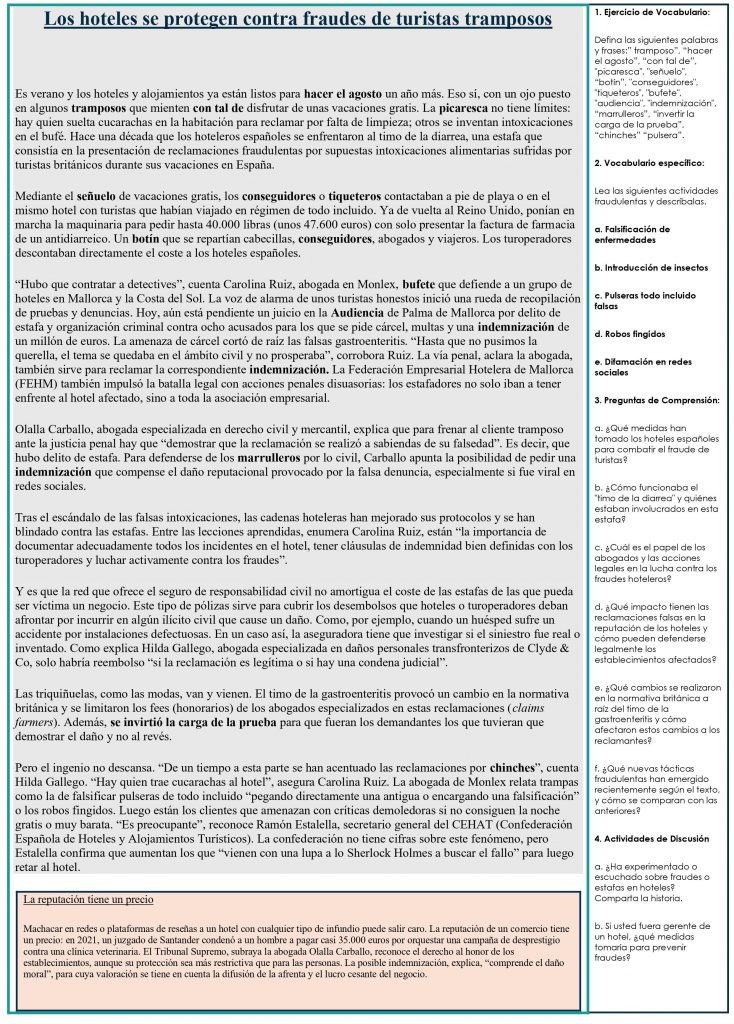
- Fraude contra hoteles

- Las expresiones del día: “Ofrecer Prueba” y “Producir Prueba”

In legal proceedings, the terms “ofrecer prueba” and “producir prueba” are crucial in the process of presenting and validating evidence.
Ofrecer Prueba: This term refers to the stage in a legal case where a party formally proposes to present certain pieces of evidence to support their claims. It involves identifying and listing the evidence that one intends to use, which could include documents, witness testimonies, expert reports, or physical items. The purpose is to inform the court and the opposing party about the evidence that will be relied upon during the trial. The noun is ofrecimiento de prueba.
Producir Prueba (Evacuar Prueba in Mexico): Once evidence has been offered, it must be produced or presented in court. This involves bringing the evidence before the judge or jury, allowing for its examination and validation. This ensures that the proposed items are available for scrutiny and can be challenged or corroborated by the opposing party. This step is critical in substantiating the claims made in a legal argument. The noun is producción de prueba (evacuación de prueba).
In a nutshell:
• Ofreciemiento de Prueba sets the stage by indicating what evidence will be used.
• Produccción de Prueba brings the evidence into the courtroom, making it a tangible part of the case. dc - La expresión del día: Derecho de Amparo

If you explore the vast landscape of the Spanish language, amparo might be defined as ‘protection‘ or ‘shelter‘. However, in the realm of Legal Spanish, it navigates deeper waters. A masculine noun (el/un amparo), its origins can be traced back to the Latin “amparare”, which denotes ‘to protect’. In the English legal context, the closest equivalent might be “writ of protection” or “constitutional remedy”. In Legal Spanish, derecho de amparo refers to the right of protection against any act or omission of public authorities or individuals which violates the fundamental rights and guarantees established by the Constitution. This is a pillar of the justice system in many Latin American countries, ensuring that the basic rights of individuals aren’t trespassed upon. In Mexico, for instance, the juicio de amparo is a constitutional process that protects the fundamental rights of individuals against acts of any authority. It’s like an armor, safeguarding the liberties of the citizenry. And here, we uncover another term: ampararse, a verb which means to seek or request this very protection. If someone feels that their fundamental rights are being violated, they can ampararse, invoking this legal protection against potential harm. In essence, derecho de amparo is the legal system’s way of ensuring a checks-and-balances mechanism, ensuring that power isn’t absolute and individuals can find refuge in the constitution when they feel threatened. Just as the term tipo is foundational in understanding criminal law, amparo is key to fathom the ways in which individual rights are upheld in the face of potential infringement. Consider this: In the age of digital transformation and cyber activities, what happens when a government entity invades the digital privacy of an individual? In several Latin American nations, the individual can invoke derecho de amparo to challenge this intrusion, ensuring that even in the digital sphere, fundamental rights are sacrosanct. A historical nugget: During the 19th century, various Latin American nations, inspired by the French and US constitutional doctrines, adopted the derecho de amparo as a means to fortify their newly formed republics against potential autocratic rule. It was, and remains, a beacon of hope, a legal tool that ensures the promise of liberty isn’t just a written word but an actionable right. My Constitutional Law professor often remarked that the ‘Derecho de Amparo’ is like Habeas Corpus, but for all constitutional rights other than personal freedom. dc
- LA PALABRA DEL DÍA: AGRAVIO

When delving into the vast domain of Legal Spanish, the word agravio stands out as an intriguing term. Directly translated to English, agravio means ‘grievance,’ ‘affront,’ or ‘insult.’ But within the legal lexicon of Spanish-speaking countries, its meaning expands considerably.
This word has its origins in the Latin term gravāre, which means ‘to weigh down’ or ‘to burden’. It captures the essence of causing harm or placing an undue burden upon someone.
In the legal realm, agravio is often used in contexts like agravio comparativo, which can be likened to ‘comparative grievance’ or ‘discrimination.’ It is used to describe a situation where a person or group is treated less favorably than another in a comparable situation without justification. The term holds significant importance in areas of law such as labor, civil rights, and equality legislation.
Taking an example from Spain, in 1883, the Segundo Congreso Catalanista presented a memorial to the King Alfonoso XII that speaks of the rectification of “historical grievances” (agravios históricos). This alludes to past actions or decisions that were perceived as unfair or discriminatory against Catalonia, underscoring the depth and weight the term agravio holds within various legal and societal contexts.
Another derivative of this term is agravios no reparados, which can be seen in some Spanish legal codes, indicating “unredressed grievances“. These are instances where the harm or grievance has not been rectified or compensated.
Diving into a historical application of agravio: In 17th century Spain, an infamous case involved a nobleman who felt “agraviado” (aggrieved) when another noble falsely accused him of theft. The accuser, realizing his mistake, sought to rectify the situation. However, the aggrieved party believed that a mere apology would not suffice to address the agravio he suffered. This case was foundational in shaping the legal and societal understanding of the gravity and ramifications of agravio.
As we navigate the labyrinth of Legal Spanish, it becomes clear that understanding terms like agravio is not just about dictionary definitions but also about comprehending the cultural, historical, and legal contexts in which they are placed. Like tipo, the word agravio underscores the unique intricacies of the Spanish legal system and its rich tapestry of history and societal norms. dc - La economía española

Practique el vocabulario, escuche el audio sobre la economía española y haga la tarea que le sigue sobre el texto que escuche:
- La expresión del día: Derechos Reales

In Legal Spanish, “Derechos Reales” is a term used in the legal system to refer to a set of rights that are granted to individuals or entities over a particular asset or property. These rights are called “real” because they are directly related to rights over things (res in Latin.
The concept of “Derechos Reales” is similar to the concept of “property rights” in common law systems, but it includes a wider range of legal rights that can be granted over a property. In Spanish and Latin American legal systems, these rights are specifically defined in codes which establishe the legal framework for rights over things.
Some examples of “Derechos Reales” in our legal systems include:
Propiedad: This is the most complete and absolute right that can be granted over a property. The owner of a property has the right to use, enjoy, and dispose of it freely, as long as this does not infringe on the rights of others.
Usufructo: This is a right that allows a person to use and enjoy a property that belongs to someone else, without owning it. The holder of the usufruct has the right to use and enjoy the property as if they were the owner, but they cannot sell or dispose of it. The owner keeps the nuda propiedad: naked ownership. My opinion is that usufructo is the closest legal institution we have to what in England is called leasehold.
Servidumbre: This is a right that allows a person or entity to use an immobile thing (real estate) in a particular way, even if they do not own it. For example, a person may be granted a servidumbre to use a private road that runs through someone else’s property.
Hipoteca: This is a right that a lender can claim over a property as security for a loan. If the borrower defaults on the loan, the lender has the right to foreclose on the property and sell it to recover the debt.
Derecho de Superficie: This is a right that allows a person or entity to use and occupy the surface of a property for a specific purpose, such as building a structure or conducting mining activities.
These are just a few examples of the different types of “Derechos Reales” that can be granted over a thing. Each of these rights is subject to specific legal requirements and limitations, and they can be transferred, inherited, or revoked under certain circumstances.
Overall, “Derechos Reales” play an important role in the Spanish and Latin American legal system, as they allow individuals and entities to exercise a degree of control over a particular asset or thing, while also protecting the rights of other parties who may have an interest in the same thing. - La palabra del día: Solvente

Adjective. Able to respond to an economic debt or take charge of an obligation. E.g.: Escrivá defiende que la Seguridad Social es “solvente” y reconoce la falta de personal: Escrivá stresses that the public pension system is “solid and solvent”.
The noun is la solvencia. E.g.: Motivos que dificultan la concesión de una hipoteca ajenos a la solvencia: Reasons that make it difficult to grant a mortgage other than solvency. The verb is solventar. E.g.: Para poder solventar los gastos de la vivienda, subalquilaba dos habitaciones: To be able to afford the apartment she sublet two rooms.
In another note, solvente, as a noun, means solvent; the liquid in which a solid is dissolved to form a solution. I used to deal with it a lot when I was a child and ‘helped’ my father with his job as a carpenter to remove paint from wood. dc - La palabra del día: Coacción

Feminine noun. This term has two interrelated meanings: 1. Force or violence done to someone to force him/her to say or do something; 2. legitimate power of the Law to enforce compliance or prevail over its infringement. E.g.1: La acusación debe demostrar sus argumentos sin recurrir a pruebas obtenidas por coacción o por fuerza: The prosecution must prove its case without resort to evidence obtained through coercion or oppression. E.g.2: De hecho, el Estado central tiene menos poder de coacción en las regiones porque éstas se autofinancian y no siempre tienen…: Indeed, the central State has less coercive power in the regions because they are self-financed and do not always have the…
The adjective is coactivo/a, and the adverb coactivamente.
When I moved to Rome from Argentina in 2001, one of the first words from romanesco I learned was coatto. Thanks to my knowledge of Legal Spanish, I immediately guessed its meaning: a bully. Study legal Spanish with me and you will not just learn, you will also open your mind. dc - La palabra del día: Entrada en vigor

Feminine noun. Beginning of the effectiveness of a legal norm.
The verb is entrar en vigor. E.g.: Como regla general, si en ella no se dispone otra cosa, entra en vigor a los veinte días de su publicación en el Boletín Oficial del Estado (CC, art. 2.1): As a general rule, if it does not provide otherwise, it enters into force twenty days after its publication in the Official State Gazette (CC, art. 2.1). dc - La palabra del día: Facultad

Femenine noun. You may have heard this term several times and you may have translated it as ‘university college’. E.g.: Faculatad de Derecho: College of Law.
In Legal Spanish, facultad has two more meanings: 1. power or right to do something. E.g.: El derecho subjetivo es la facultad propia de un sujeto para realizar o no una cierta conducta: The subjective right is the power of a person to carry out or not a certain conduct. 2. Physical or moral aptitude to do something. In the first case, facultad can be a synonym of potestad; in the second case, a synonym of capacidad.
The verb is facultar: to empower, and the adjective facultativo/a: optional.
On another note: un/a facultativo/a, noun, is a doctor: Sanidad no encuentra un sustituto que supla al facultativo durante sus vacaciones por el plan de contingencia por la pandemia: The Health Department cannot find a substitute to replace the doctor during his holidays due to the contingency plan for the pandemic I cannot imagine the link. dc - La palabra del día: Perito/a

Adjective, mainly used as a noun. Expert or knowledgeable in something. As a noun, in Legal Spanish we use this term to make reference to the expert who gives evidence in a hearing (audiencia pericial) or by a document (informe pericial). E.g.: Homicidio de Tino John: Un perito afirma que no hubo enfrentamiento: Homicide of Tino John: An expert witness affirms that there was no confrontation.
The adjective is pericial and the verb is peritar: to judge expertly.
My country has a famous glacier in the South called Perito Moreno. When I was a child, I assumed that Perito was the Christian name of a chap called Moreno, or a version of Pedrito (Pete), after all everybody called my father Pierino (Pete in Italian); but no, Mr. Moreno was an Argentine explorer who in 1902 was appointed perito, in which capacity he disproved Chilean claims to the continental divide in the Southern Cone and he was awarded with a glacier named after him. His name was Francisco Pancracio Moreno. I guess you understand why we prefer to call him just Perito. dc - La palabra del día: Adjudicar

Verb. To assign or attribute something to a person or thing. E.g.: Registraduría adjudicó por $1,23 billones la licitación para organización de elecciones: The Registrar’s Office awarded the tender for the organization of elections for $ 1.23 billion.
The noun is la adjudicación: Transporte urbano: Austin quiere conocer el criterio de adjudicación a la empresa Ceferino: City transport: Austin wants to know the award criteria to the Ceferino company. The person is el/la adjudicatario/a: E.g.: TraficoPort S.L., adjudicataria provisional del servicio de coordinación del Puerto: TraficoPort S.L., provisional awardee of the Port coordination service. dc - La palabra del día: Contribuyente

Masculine and feminine noun. Person required by law to pay a tax. E.g.: Asamblea Nacional exhorta al Gobierno por facilidades de pago de impuestos a los contribuyentes de El Oro: National Assembly urges the Government for tax payment facilities to the taxpayers of El Oro.
The verb is contribuir: to contribute. Another noun with the same root is la contribución. dc - La palabra del día: Auditoría

Feminine noun. From the Latin verb audire, which means ‘ to hear’, which in turn has its origin in the first auditors who exercised their function judging the truth or falsehood of what was submitted to their verification, mainly by observing. Generally, it is the action of verifying that a certain event or circumstance occurs according to plan, but if we talk about the auditoría in an organization, it refers to the tests carried out on financial, operational or administrative information with based on compliance with legal or tax obligations, as well as the policies and guidelines established by the entity itself according to the way it operates and is administered. An Auditoría can also be the department inside an organization with those functions.
E.g.: Auditoría del Edomex reportó irregularidades por 15,000 mdp, más del 10% relacionadas con el Salario Rosa: Edomex audit reported irregularities for 15,000 million pesos, more than 10% related to the Pink Salary.
The person is called el/la auditor/a and the ver is auditar: auditar las cuentas. dc - La palabra del día: Historial de crédito

Masculine noun. Also called historial crediticio and reporte de crédito. Report that details the most relevant information about the financial profile of a natural or legal person. Therefore, it provides information of interest on aspects related to the solvency of the person who is going to request a loan or to enter into a contract. E.g.: Cómo conseguir una hipoteca o préstamo personal aún teniendo mal historial crediticio: How to get a mortgage or personal loan even with bad credit history. dc
- La palabra del día: Adjudicatario/a

Masculine and feminine noun. In Legal Spanish, this term is used in Civil and Administrative Law and it refers to the person who offers the last and highest bid in a public auction sale of a piece of furniture or a property and to any person recipient of an award. E.g.: El Pliego de Prescripciones Técnicas del contrato recoge que la empresa adjudicataria deberá hacerse cargo del suministro de moqueta ferial con determinadas características: The Technical Specification Sheet of the contract states that the winning company must be in charge of the supply of carpet for the trade fair with certain characteristics.
The award is called la adjudicación and the verb is adjudicar. E.g.: El Pentágono cancela un contrato multimillonario con Microsoft tras su polémica adjudicación: Pentagon cancels multi-million dollar contract with Microsoft after controversial award; Pájara, a punto de adjudicar 1,5 millones en obras para “dotar de servicios mínimos” a la urbanización de La Pared: Pájara, about to award 1.5 million in works to “provide minimum services” to the urbanization of La Pared. dc - La palabra del día: Denegar

Verb. Not granting what is asked or requested. E.g.: Gobierno denegó permiso de trabajo a periodista estadounidense de medio digital El Faro: Government denied work permit to US journalist from online newspaper El Faro.
The noun is la denegación. As you can see, denegar derives from negar: to deny, reject. In this case the noun is la negación. Both adjectives are denegable and negable. What is the main difference between negar and denegar? The actor of the verb denegar is an authority, and what is being denied is something which is in the power of that authority to concede. dc - La palabra del día: Subsanar

Verb. This term has the same root of sanar, sano: to heal, healthy. It is almost exclusively used in a legal context and it has two different meanings somehow related: 1. To repair or remedy a defect. E.g.: El problema de los uniformes para criollos van a Tokio se subsanó: The problem of uniforms for Dominican athlets going to Tokyo was corrected. 2. To compensate a damage. E.g.: Siempre resulta más barato evitar o prevenir el fraude que intentar subsanar los daños a posteriori y a un elevado coste: It is always cheaper to avoid or prevent fraud than it is to attempt, after the event and at great expense, to put things right.
In both cases the noun is la subsanación. dc - La palabra del día: Emparejar

Verb. This term has several meaning an all of them somehow related. I am sure it must have the same root of par (pair) and if you check in the dictionary you will see it translated as ‘to match, to pair’. In Economics, emparejar means ‘to bring something on a level with something else’. E.g.: Ya hay 170 empresas comprometidas para emparejar los sueldos en Chile: There are already 170 companies committed to pair up salaries in Chile (between genders).
The noun is el emparejamiento and the adjective is parejo/a/s: equal. A noun with the same root is pareja: partner (in life, board games, cards, etc.) dc - La palabra del día: Traslado

Masculine noun. In Legal Spanish, we call traslado the notification of judicial writings that one of the parties must make to the other. For example, the traslado of the claim is the communication that the defendant receives of what is imputed or claimed, in order to be able to make exceptions if there were any. E.g.: Una vez sea realizada la evaluación, se debe dar traslado por un día para presentar observaciones: Once the assessment is carried out for one day it must be studied in order to make observations.
The lexical locution is dar traslado or, if you are really pompous, conferir traslado. From the point of view of the party who is being notified, the lexical locution is recibir traslado. What is the main difference between the expressions notificar and dar traslado?: The party who recibe traslado has the right to make expceptions in a due term. Notificar is a more generic word that not necessarily implies the right to make exceptions or observations. We introduce the term in wich the other party has to make exceptions with the preposition por: Dar traslado por 10 días.
By the way, trasladar(se) also means to move a house, a firm, etc., and the noun is also el tralsado. dc - La palabra del día: Devengación

Feminine noun. This term is used almost exclusively in a legal context and it refers to the acquisition of the right to some perception or remuneration for reasons of work, service or other title. The verb is devengar. E.g.: CGR determinó que no procede devengar obligación de pagar bienes y servicios que no se han recibido conforme: The National Audit Office determined that it is not appropriate to accrue an obligation to pay for goods and services that have not been received in accordance.
We also use these terms with the expressions devengar intereses and devengación de intereses: to accrue interest, interest accrual. The adjective is devengado/a/s: intereses devengados: accrued interests. dc - La palabra del día: Reivindicar

Verb. This term has three main meanings: 1. To claim something to which one thinks one is entitled. E.g.: Itaembé Guazú: con múltiples actividades reivindicaron los derechos de la niñez y la juventud: Itaembé Guazú: with multiple activities they called for the rights of children and youth. 2. To argue in favor of something or someone. E.g.: Alberto Fernández reivindicó la rebeldía de los jóvenes: “Los necesito movilizados”: Alberto Fernández advocated the rebellion of the youth: “I need you mobilized”. 3. To claim the authorship of an action for oneself. E.g.: Talibanes de Pakistán reivindican atentado que dejó cuatro muertos cerca de frontera afgana: Pakistan Talibans claim responsibility for attack that left four dead near Afghan border.
The noun is la reivindicación and the adjective reivindicativo/a. dc - La palabra del día: Opa
Singular feminine noun. Public offering aimed at the partners of a company listed on the stock market proposing the acquisition of their shares in specified terms and conditions. E.g.: El Gobierno aprueba con condiciones la opa de IFM sobre el 22,7% de Naturgy: The Government approves with conditions the IFM takeover bid for the 22.7% of Naturgy.
As you can see, opa is acronym and it stands for Oferta Pública de Adquisición. Of course, we do not have a verb for this noun. The lexical expression is hacer una opa.
On a different note, in my country, opa is an old-fashioned adjective, usually used as a noun, that means something like idiot, stupid. It is actually pretty offensive. So, do not mix up hacer una opa with hacerse el opa. dc - La palabra del día: Pujar

Verb. This term has lots of different meanings and all of them somehow related to making force or trying to overcome an obstacle. For example, pujar is what a a woman does when is delivering a baby. In this case the noun is el pujo. E.g.: Todo lo que necesitas saber sobre los pujos del parto: Everything you need to know about labor pushes. We can guess the same origin of empjuar: to push.
But this blog is about Legal & Business Spanish and in Business Spanish pujar has a rather different meaning: to increase the price put to something that is auctioned. E.g.: Mecenas de Xàtiva compran la ‘Inmaculada’ por la que nadie pujó: Patrons of Xàtiva buy the ‘Immaculate’ for which nobody bid. In this case the noun is la puja. E.g.: El Huesca y el Swansea se unen a la puja por Peybernes: Huesca and Swansea join the bid for Peybernes. We are still somehow speaking about pushing prices up. dc - La palabra del día: Gravamen

Masculine noun. Tax that is applied on a property, a property or the wealth of a person. E.g.: Se introduce un gravamen del 5 % del valor catastral para aquellas sociedades que posean inmuebles en nuestro país: a tax of 5% of the cadastral value is introduced for those companies that own real estate in our country.
The verb is gravar. E.g.: El Gobierno busca gravar la leche y la oposición salió al cruce: The Government seeks to tax milk and the opposition criticized it. dc - La palabra del día: Requisitos

Masculine noun, usually in plural. Circumstance or condition necessary for something. E.g.: Plan para terminar con los requisitos legales para las mascarillas el 19 de junio: Plan to end legal requirements for masks on June 19.
The verb is requerir: to request. Another verb with the same root is requisar (to confiscate) although their meanings are not related. The noun of requisar is la requisición. dc - La palabra del día: Alta

Feminine noun. This term has many meanings. Let’s see the ones that may be of interest to us.
1. Authorization given by the doctor for the reinstatement of a patient to ordinary life and also the documents that attest the discharge. We also call it el alta médica. The lexical locutions here are dar el alta (médica) de (el hospital/la clínica) and recibir el alta.
2. Act in which the taxpayer declares to the Treasury the exercise of industries or professions subject to tax. The lexical locution is darse de alta en and dar de alta en E.g.: Me di de alta como autónomo en la oficina de impuestos: I registered as a freelancer at the tax office; La oficina de impuestos me dio de alta en el sistema en enero de 2005: The tax office added me to the system in January 2005. In this case, the tax form to register in an industrial or professional activity is also called el alta.
3. Registration of a person in a service, professional body, association, etc., and the document that accredits such registration. The lexical locutions are also darse de alta en and dar de alta (en). E.g.: Si usted quiere darse de alta en el servicio puede hacerlo desde aquí: If you wish to register with the service, you can do so from here.
Note that the singular determinate and indeterminate articles we use with alta are always the masculine el and un: El alta, un alta. This is because of the combination of two reasons: 1. Alta is a feminine noun starting with a tónica (with the stress in the a); 2. In Spanish we do not have apostrophe. In the plural form the articles revert to the feminine form: las altas, unas altas. In amiga, we say la amiga because the stress is not in the first ‘a’ but in the ‘i’.
Remember, alta is always a feminine noun, even with the masculine article in front of it. E.g.: El alta médica. As far as I know, in Spanish we have just one word which is masculine in the singular and feminine in the plural; arte: el arte español del Siglo de Oro, las Bellas Artes.